 BUY NOW
 Wavelength Stabilization Selection
Volume Bragg Grating (VBG) Lasers
Compare VBG-stabilized laser diodes by wavelength, spectral requirements, power, beam delivery, and integration needs.
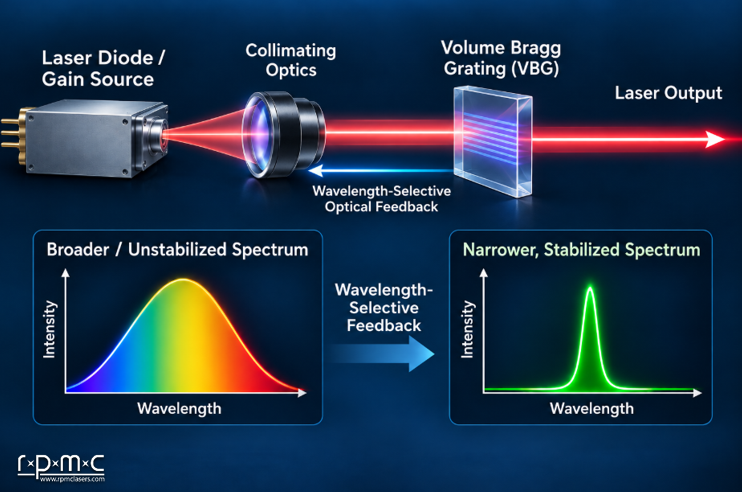
Volume Bragg grating (VBG) stabilization uses an external wavelength-selective grating to help control the emission wavelength and spectral behavior of a laser diode. VBG-stabilized sources are available across very different power levels, package styles, beam formats, and spatial-mode configurations.
VBG architecture does not by itself define the exact linewidth, single-frequency behavior, wavelength drift, beam quality, or output power. Those characteristics depend on the specific laser, emitter architecture, grating design, package, and operating conditions.
Key Selection Considerations
- Target wavelength: Required center wavelength and allowable wavelength tolerance or drift.
- Spectral performance: Required linewidth, side-mode suppression, or single-frequency behavior where applicable.
- Output power: Required optical power and whether the source is single-emitter or multi-emitter.
- Beam requirements: Spatial mode, beam quality, free-space or fiber-coupled delivery, and polarization where important.
- Fiber interface: Fiber core, numerical aperture, connector, and delivery format for fiber-coupled systems.
- Integration: Package, cooling, monitoring, back-reflection sensitivity, controls, and OEM constraints.
Need a wavelength-stabilized diode but not sure which configuration?
Send RPMC the target wavelength, power, linewidth or stability requirement, output format, and package constraints you know. We can help compare the available VBG-stabilized options.
When Should I Consider a VBG-Stabilized Laser?
A VBG-stabilized laser is worth considering when the center wavelength or spectral behavior of a conventional laser diode needs tighter control, but the application also has practical requirements around output power, beam delivery, package, or OEM integration.
Depending on the source, VBG stabilization can be used with lower-power single-emitter lasers or much higher-power multi-emitter configurations. The important question is not simply whether the source uses a VBG, but what wavelength stability, linewidth, output power, and beam characteristics the application actually requires.
VBG Stabilization Does Not Automatically Mean SLM
VBG describes the wavelength-selective feedback method, not a universal operating mode. Some VBG-stabilized lasers may provide single-frequency or single-longitudinal-mode operation, while others use VBG stabilization to control the spectrum of much higher-power multi-emitter sources. If strict SLM operation is required, verify it at the product or configuration level rather than assuming it from the VBG architecture alone.
Compare VBG-Stabilized Laser Options
Use the filters below to compare available VBG-stabilized laser diodes by wavelength, power, output format, and other relevant characteristics. RPMC can help determine which configuration provides the right balance of spectral control, power, beam delivery, and integration.
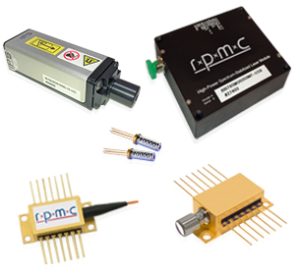
| Picture | Part Number | Wavelength (nm) | Description | Type |
|---|---|---|---|---|
|
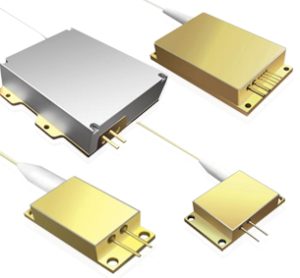
RPK-IR-STAB | 785, 808, 878, 976, 1064 | Laser Diode, Wavelength Stabilized, Fiber-coupled, Infrared, 760-1400nm, up to 430W | Multi-Emitter, VBG, Narrow Linewidth, Fiber-Coupled |
|
RVBG | 633, 680, 785, 808, 860, 976, 1030, 1064 | Laser Diode, Stabilized, 633-1064nm, up to 600mW | LD Module, Single Emitter, VBG, Narrow Linewidth, Single Longitudinal Mode (SLM), Fiber-Coupled, Made in the USA |
What Should I Specify for a VBG-Stabilized Laser?
You do not need every specification finalized before contacting RPMC. Start with the requirements that are fixed and identify where the system has flexibility.
Wavelength & Spectral Requirements
- Target wavelength or wavelength range
- Allowable wavelength tolerance or drift
- Maximum acceptable linewidth, if specified
- Whether single-frequency / SLM operation is required
- Side-mode suppression or noise requirements
- Operating temperature range
- Fixed-wavelength or tunable requirement
- Application-specific spectral constraints
Power, Beam & Integration
- Required optical power
- Single-emitter or higher-power multi-emitter needs
- Free-space or fiber-coupled output
- Fiber core diameter and numerical aperture
- Connector or fiber-delivery requirements
- Spatial-mode or beam-quality requirements
- Package, cooling, monitoring, or control constraints
- Application, quantities, and project timeline
If some of these specifications are still unknown, share the application and the requirements you already have. RPMC can help determine which parameters actually control the selection and whether VBG stabilization is the right approach.
Know the Performance Requirement but Not the Stabilization Method?
If your requirement is defined primarily by linewidth, coherence, frequency stability, or single-frequency operation, start with our Narrow Linewidth Lasers or Single Longitudinal Mode Lasers. RPMC can help determine whether VBG, DFB, FBG, or another wavelength-control approach is appropriate.
Related Spectral-Control Options
- Narrow Linewidth Lasers – when linewidth, coherence, or spectral width is the primary requirement.
- Single Longitudinal Mode Lasers – when single-frequency / SLM operation itself is required.
- Distributed Feedback (DFB) Lasers – for sources using integrated distributed-feedback architecture.
- Fiber Bragg Grating (FBG) Lasers – for sources using fiber-Bragg-grating feedback.
Need a wavelength-stabilized laser diode matched to a specific requirement?
Share the wavelength, power, spectral requirement, output format, and integration constraints you already know. RPMC can help compare the available VBG-stabilized configurations.