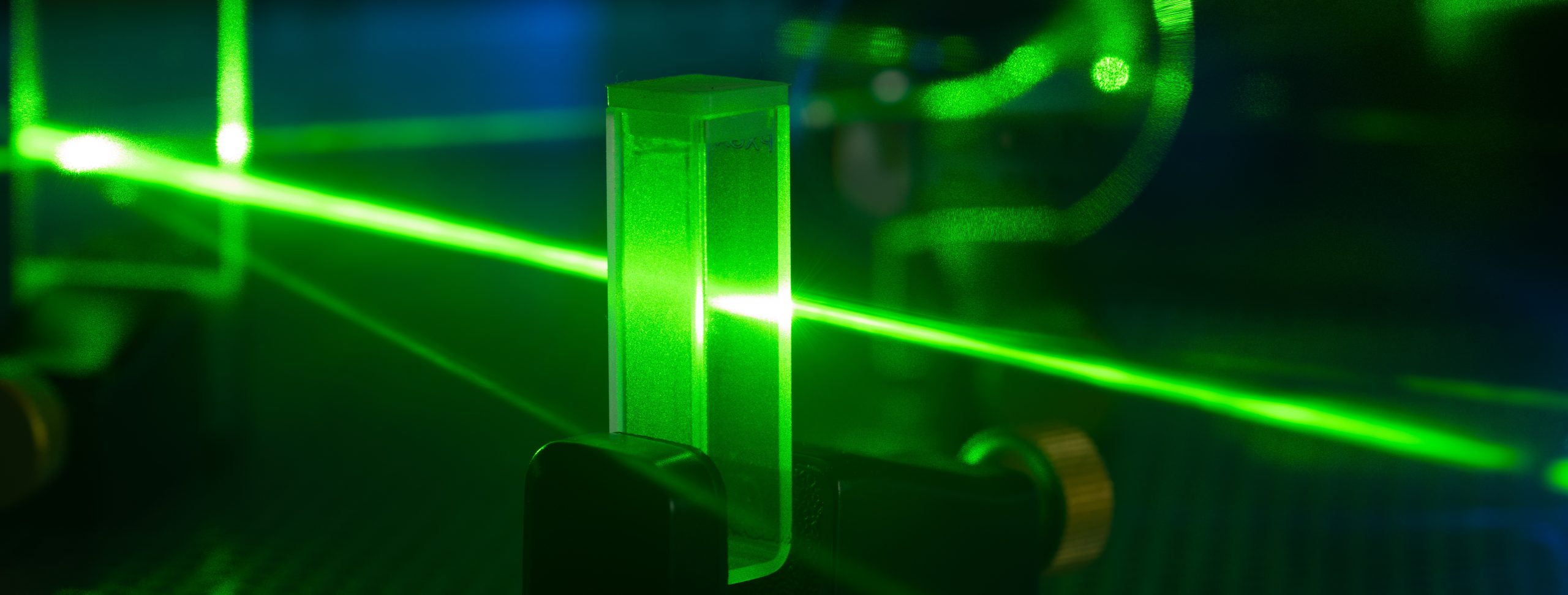


Pulsed laser selection involves more than matching a wavelength or headline power specification. Pulse width, pulse energy, repetition rate, average and peak power, beam characteristics, timing, controls, packaging, and operating environment can all affect which laser architecture and configuration makes sense.
RPMC works across a broad range of pulsed laser technologies and manufacturers. Tell us what your application needs to accomplish, and we can help determine whether an existing standard laser already fits, a configurable or modified platform is the better path, or deeper customization is actually necessary.
 Pulse Performance
Define the pulse characteristics that matter to the application, including pulse width, pulse energy, repetition rate, average power, peak power, and operating mode.
 Wavelength & Spectral Properties
Evaluate the required wavelength/wavelength range, linewidth or bandwidth, spectral stability, harmonic generation, and other wavelength-dependent performance needs.
 Beam & Output Requirements
Compare beam quality, beam diameter and divergence, polarization, free-space or fiber delivery, and other optical-output requirements that affect system performance & integration.
 Timing, Triggering & Controls
Identify external triggering, synchronization, jitter, single-shot or burst operation, adjustable repetition rate, modulation, communications, and other control requirements.
 Packaging, Cooling & Integration
Define package dimensions, weight, mounting, cooling, electrical interfaces, control electronics, OEM configuration, and other mechanical or system-level constraints.
 Environmental & OEM Requirements
Tell us about operating temperature, shock, vibration, airborne or space constraints, ingress protection, production quantities, qualification needs, or other program-specific requirements.
A custom requirement does not always require a completely new laser design. RPMC starts by looking for the lowest-complexity solution that can honestly meet the application’s critical performance and integration requirements.
Path 1
An existing product already meets the critical wavelength, pulse width, pulse energy, repetition rate, power, beam, timing, and integration requirements.
Path 2
An existing laser platform can meet the requirement through available wavelength, pulse, repetition-rate, optical, control, cooling, packaging, or interface options.
Path 3
A proven laser architecture is the right starting point but requires greater customization to its optical, mechanical, electrical, environmental, or control configuration.
Path 4
When standard & configurable platforms can’t meet critical requirements, RPMC evaluates more application-specific development paths with the appropriate manufacturing partner.
The goal is to meet the requirement with the most practical solution, not to make the laser more custom than necessary.
RPMC can help balance pulse performance, optical requirements, integration, program risk, quantity, schedule, and cost while determining how far customization actually needs to go.
You do not need a finalized laser specification before contacting RPMC. Start with the application and the requirements you already know. We can help determine which remaining parameters actually drive the laser selection and how much customization is necessary.
If some specifications are still flexible, that is useful information. Knowing which requirements are mandatory and which can move may open the door to a standard or configurable platform that avoids unnecessary development time and complexity.
Custom pulsed laser selection is rarely about finding the highest pulse energy, shortest pulse width, or closest wavelength in isolation. The important parameters interact, and different laser architectures may solve the same application in very different ways.
RPMC works across multiple pulsed laser manufacturers and architectures, helping you compare viable approaches instead of forcing the requirement into one product family.
We help separate critical requirements from specifications that may still have flexibility, making it easier to identify the most practical standard, configurable, modified, or custom path.
RPMC can help communicate the application and requirements to the appropriate manufacturing partner, work through technical questions, and support the configuration and quotation process.

I need a low SWaP solution.
RPMC has a long history in the Military markets and has worked with every major defense contractor in the US. We utilize our in-house knowledge and expertise to highlight limiting factors and suggested considerations to be made when sourcing efficient, compact, and portable laser sources, and guide you to the right laser for your application.
I need a very high-quality cut, with minimal thermal defects and HAZ.
We understand that one person’s definition of high-quality isn’t always the same as the next. RPMC Lasers was one of earliest providers of industrialized ultrafast lasers in the market. We work closely with our customers to understand their requirements and provide apps lab and process development solutions to produce proof of concepts for your program needs.
I have a very challenging environment that I am working in and am worried about consistent laser performance.
We’ve fielded solutions to every environment known to man. Our experienced staff will review your complete and overall performance requirements to ensure that the solution we propose meets or exceeds all performance considerations, including environment.
My neighbor is driving me crazy. I saw this movie one time and was thinking…
Ummm, as much as the nerd inside of me would like to help… we’re going to have to pass on this one.

Keep up to date with the latest products, informative articles, industry news, and announcements!

 BUY NOW