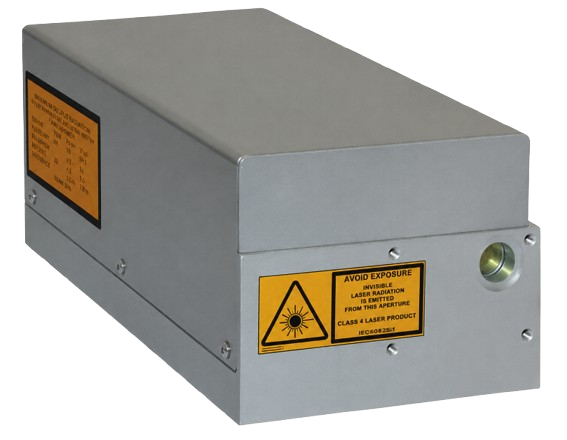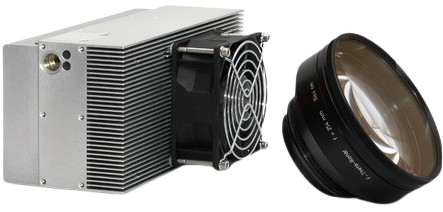

Wedge

DPSS Laser, ns/ps pulsed, 266-3000nm, up to 4mJ, up to 100kHz

Key Features:

  • Flexible short-pulse DPSS platform from 266 nm to ~3 µm
  • ns/ps pulse options w/ mJ-class pulse-energy configurations
  • Compact, sealed, rugged design for OEM integration
  • Air-cooled platform with water-cooling options available
  • Configurable beam delivery, fiber coupling, timing, monitoring, cooling, packaging

Wedge is a great fit when wavelength, pulse width, pulse energy, timing, beam delivery, packaging, or environmental needs drive the final configuration.

Share your application & laser requirements. RPMC can help determine which Bright Solutions platform is the right starting point.


POPULAR CONFIGURATIONS:

Picture
Part Number
Part Description
Datasheet
 
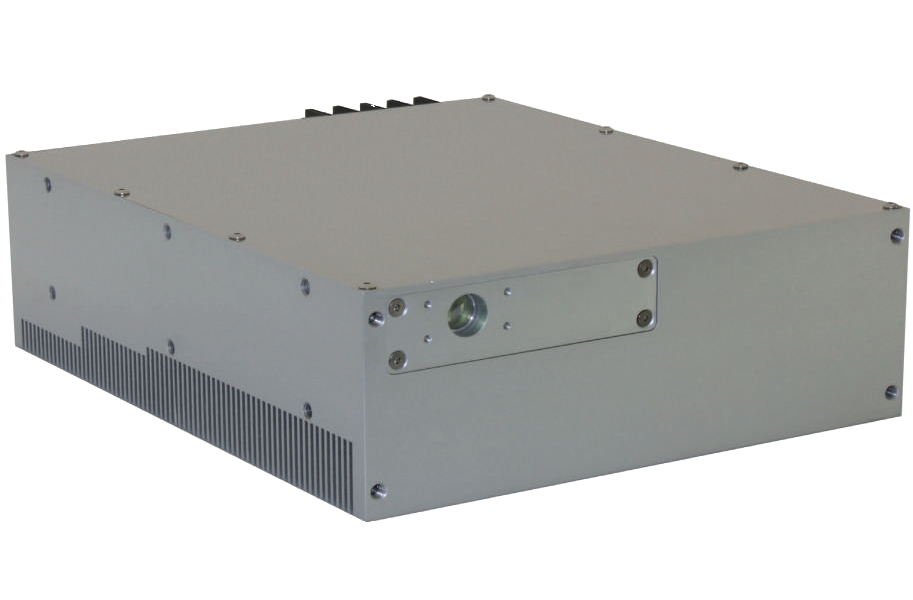
clean, modern, silver colored OEM DPSS Laser housing WEDGE HB 1064nm

Compact Nanosecond Laser, 1064nm, 2mJ, 1.5ns, 2kHz

PDF icon Get Quote
clean, modern, silver colored OEM DPSS Laser housing WEDGE HB 532nm

Compact Nanosecond Laser, 532nm, 1mJ, 1.5ns, 2kHz

PDF icon Get Quote
clean, modern, silver colored OEM DPSS Laser housing WEDGE HF 1064nm

Compact Nanosecond Laser, 1064nm, 180 uJ at 10kHz, 700 to 2500 ps, 10 to 100 kHz

PDF icon Get Quote
clean, modern, silver colored OEM DPSS Laser housing WEDGE HF 532nm Plus

Compact Nanosecond Laser, 532nm, 3.5W at 50 kHz, 700 to 2000 ps, 30 to 100 kHz

PDF icon Get Quote
clean, modern, silver colored OEM DPSS Laser housing WEDGE HF 532nm

Compact Nanosecond Laser, 532nm, 1.5W at 30 kHz, 700 to 2000 ps, 10 to 100 kHz

PDF icon Get Quote
clean, modern, silver colored OEM DPSS Laser housing WEDGE HF 355nm

Compact Nanosecond Laser, 355nm 800 mW, 500 to 1000 ps, 10 to 50 kHz

PDF icon Get Quote
clean, modern, silver colored OEM DPSS Laser housing WEDGE HF 266nm

Compact Nanosecond Laser, 266nm, 15uJ at 10kHz, 700 to 1500 ps, 10 to 50 kHz

PDF icon Get Quote
clean, modern, silver colored OEM DPSS Laser housing WEDGE XB 1064nm

Compact Nanosecond Laser, 1064nm, 4mJ, 1.5ns, 1kHz

PDF icon Get Quote
clean, modern, silver colored OEM DPSS Laser housing WEDGE XB 1572nm

Compact Nanosecond Laser, 1572nm, 800uJ, <2.5ns, 1kHz

PDF icon Get Quote
clean, modern, silver colored OEM DPSS Laser housing WEDGE XB 532nm

Compact Nanosecond Laser, 532nm, 2mJ, 1.5ns, 1kHz

PDF icon Get Quote
clean, modern, silver colored OEM DPSS Laser housing WEDGE XB 355nm

Compact Nanosecond Laser, 355nm, 0.6mJ, 1.5ns, 1kHz

PDF icon Get Quote
clean, modern, silver colored OEM DPSS Laser housing WEDGE XB 3100nm

Compact Nanosecond Laser, 3100nm, 100uJ, 3ns, 2kHz

PDF icon Get Quote
clean, modern, silver colored OEM DPSS Laser housing WEDGE XB 266nm

Compact Nanosecond Laser, 266nm, 0.5mJ, 1.8ns, 1kHz

PDF icon Get Quote
clean, modern, silver colored OEM DPSS Laser housing WEDGE XF 1064nm

Compact Nanosecond Laser, 1064nm, 70 uJ at 10kHz, 400 to 1500 ps, 10 to 100 kHz

PDF icon Get Quote
clean, modern, silver colored OEM DPSS Laser housing WEDGE XF 1064nm Plus

Compact Nanosecond Laser, 1064nm, 4W at 80 kHz, 400 to 1600 ps, 50 to 200 kHz

PDF icon Get Quote
clean, modern, silver colored OEM DPSS Laser housing WEDGE XF 532nm Plus

Compact Nanosecond Laser, 532nm, 2W at 100 kHz, 400 to 1500 ps, 50 to 200 kHz

PDF icon Get Quote
clean, modern, silver colored OEM DPSS Laser housing WEDGE XF 532nm

Compact Nanosecond Laser, 532nm, 30 uJ at 10kHz, 400 to 1000 ps, 10 to 100 kHz

PDF icon Get Quote
clean, modern, silver colored OEM DPSS Laser housing WEDGE XF 266nm

Compact Nanosecond Laser, 266nm 5uJ at 10kHz, 400 to 700 ps, 10 to 50 kHz

PDF icon Get Quote

The Wedge series is a flexible short-pulse DPSS laser platform for applications that require broader wavelength coverage, ns/ps pulse options, high peak power, rugged packaging, or application-specific configuration. Available from 266 nm to approximately 3 µm, Wedge is a strong starting point when the application requires more configuration flexibility than a compact standard nanosecond platform.

Wedge is commonly considered for OEM micromachining, LIDAR, LIBS, ablation, nonlinear optics, spectroscopy, research, and rugged industrial or airborne-style systems. Its compact, sealed, monolithic design supports integration into demanding environments where packaging, beam delivery, cooling, timing, or configuration details matter.

Start with Wedge when your application depends on:

  • Broader wavelength coverage from UV through IR/SWIR
  • ns/ps pulse options
  • mJ-class pulse-energy configurations
  • High peak power in a compact package
  • Rugged, compact, or airborne-style packaging requirements
  • Beam delivery, fiber coupling, cooling, monitoring, low-jitter, IP-rated, 28 V DC, or other custom options

Wedge is often a good starting point when the application requires broader wavelength coverage, ps-capable short-pulse operation, mJ-class pulse energy, rugged packaging, or custom beam-delivery/control options. If your requirements are closer to a compact nanosecond DPSS source, Onda or SOL may be a better starting point. For very high-pulse-energy, lower-repetition-rate requirements, Aero may be more appropriate. For ultra-compact microchip packaging, compare against SB1. RPMC can help confirm the best Bright Solutions platform based on your wavelength, pulse energy, pulse width, repetition rate, trigger/timing, output format, packaging, cooling, and application requirements.

Tell us about your application and laser requirements:

Share your wavelength, pulse energy, pulse width, repetition rate, trigger/timing needs, output format, package constraints, and application. RPMC can help determine whether Wedge or another Bright Solutions platform is the right starting point.

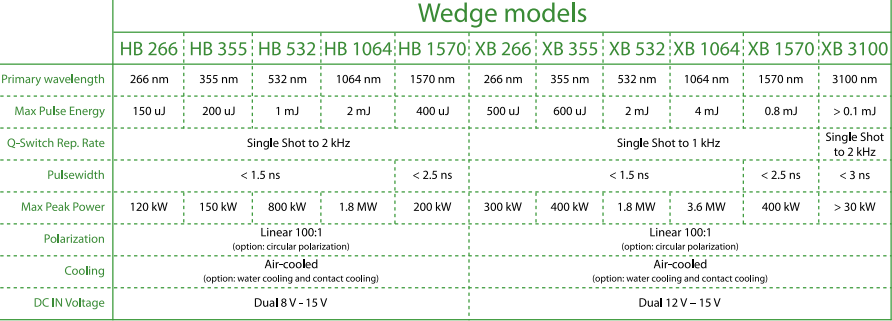
Wedge HB/XB DPSS Laser Platform Examples:

Wedge HB/XB models are the higher-pulse-energy nanosecond configurations, a good starting point when the application prioritizes mJ-class pulse energy, active Q-switch synchronization, and select UV/visible/IR wavelength options at lower repetition rates.

Endless customization options are available. Let us know what you need!
simple text table displaying configuration options for a DPSS laser

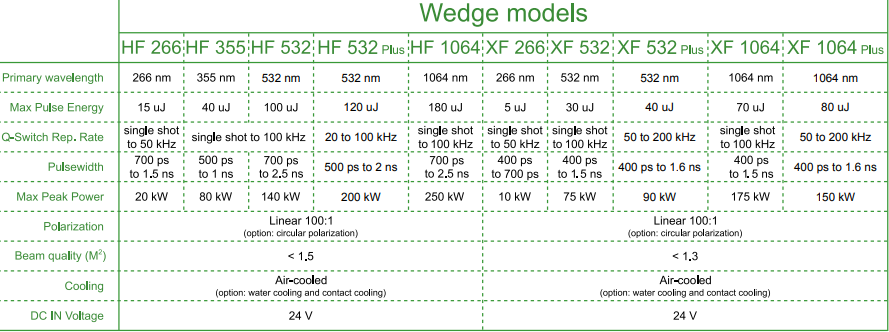
Wedge HF/XF DPSS Laser Platform Examples:

Wedge HF/XF models are the shorter-pulse, higher-repetition-rate configurations, combining active Q-switching with sub-ns pulsewidths in a compact, rugged platform for airborne, industrial, and instrumentation applications.

Endless customization options are available. Let us know what you need!
simple text table displaying configuration options for a DPSS laser

Benefits:

  • Rugged monolithic industrial design:
    Ready for action with a monolithic design, insensitive to vibrations & harsh environments.
  • High peak power up to 4 MW:
    Deeper water penetration in bathymetry applications and highly efficient material ablation.
  • Efficient & compact air-cooling:
    Smaller footprint & less maintenance while ensuring optimal performance due to low waste heat design.
  • Low SWaP airborne-ready:
    Compact, lightweight & efficient, ideal for LIDAR and aerospace applications where space is limited.

  • Short nanosecond to picosecond pulses:
    Allow for precise time-of-flight measurements, critical for distance/speed accuracy.
  • Optional beam expanding and collimation optics:
    Help shape and direct the laser beam, ensuring maximum energy is delivered to the target.
  • Optional beam separator/independent mechanical shutters:
    Allows for easy separation, independent beam control & additional safety measures.
  • Many more optional add-ons & completely customizable:
    From a red aiming beam to water cooling, beam expanding, MOPA configurations, and beyond. Let us know what you need!

Options Available

  • 266 nm to ≈ 3 um options
  • Beam expanding and collimating optics
  • Fiber Coupling
  • Low jitter option

  • Extended operating temperature range
  • IP68 package
  • 28V DC Input for airborne installation
  • Circular polarization

  • Monitoring photodiode
  • Red aiming beam
  • Remote control box & software interface
  • AC-DC power supply

Ready to confirm a Wedge configuration?

Send RPMC details of your application and laser requirements:

  • application
  • target wavelength
  • timeline
  • quantity

  • average power
  • pulse energy
  • pulse width
  • repetition rate

  • trigger/timing needs
  • output format
  • package constraints
  • cooling preference

We’ll help confirm whether Wedge, another Bright Solutions platform, or a custom DPSS configuration is the best fit.

Back to all Bright Solutions products

How can we help you?

Talk to one of our experienced product managers today!

Contact us

Pulsed Lasers FAQs

What is a Pulsed Laser?

A pulsed laser is any laser that does not emit a continuous-wave (CW) laser beam. Instead, they emit light pulses at some duration with some period of ‘off’ time between pulses and a frequency measured in cycles per second (Hz). There are several different methods for pulse generation, including passive and active q-switching and mode-locking. Pulsed lasers store energy and release it in these pulses or energy packets. This pulsing can be very beneficial, for example, when machining certain materials or features. The pulse can rapidly deliver the stored energy, with downtime in between, preventing too much heat from building up in the material. If you would like to read more about q-switches and the pros and cons of passive vs active q-switches, check out this blog “The Advantages and Disadvantages of Passive vs Active Q-Switching,” or check out our Overview of Pulsed Lasers section on our Lasers 101 Page!

What is the best laser for LIDAR?

What is the best laser for LIDAR?

There are actually numerous laser types that work well for various LIDAR and 3D Scanning applications. The answer comes down to what you want to measure or map. If your target is stationary, and distance is the only necessary measurement, short-pulsed lasers, with pulse durations of a few nanoseconds (even <1ns) and high pulse energy are what you’re looking for. This is also accurate for 3D scanning applications (given a stationary, albeit a much closer target), but select applications can also benefit from frequency-modulated, single-frequency (narrow-linewidth) fiber lasers. If your target is moving, and speed is the critical measurement, you need a single-frequency laser to ensure accurate measurement of the Doppler shift. If you want to learn more about the various forms of LIDAR and the critical laser source requirements, check out our LIDAR page for a list of detailed articles, as well as all the LIDAR laser source products we offer. Get more information from our Lasers 101, Blogs, Whitepapers, FAQs, and Press Release pages in our Knowledge Center!

What is the best laser for tattoo removal?

What is the best laser for tattoo removal?

The best laser for tattoo removal depends on factors like wavelength versatility, pulse duration, and energy output to effectively target various ink colors while minimizing skin damage. Q-switched or ultrafast lasers with pulse durations of 100 ps to 10 ns and a fluence of ~10 J/cm² are ideal for fragmenting ink via selective photothermolysis. For example, the Lampo 266-1064 nm offers multiple wavelengths (266 nm, 532 nm, 1064 nm) for multi-color tattoos, while the Nimbus 770-1064 nm provides customizable sub-nanosecond pulses for precision. The Quantas-Q1 delivers high pulse energy (up to 32 mJ at 1064 nm) for efficient treatments.

For more details on pulsed lasers for tattoo removal applications, see our blog, “Choosing the Right Laser for Tattoo Removal: Key Considerations‘! Get more information from our Lasers 101, Blogs, Whitepapers, and FAQ pages in our Knowledge Center!

We’re here to offer expert advice & to you help select the right laser for your application.
Contact Us Here or email us at [email protected]!

What is the difference between active and passive q-switching?

There are a wide variety of q-switch technologies, but the technique as a whole can be broken down into two primary categories of q-switches, passive and active. Active q-switches could be a mechanical shutter device, an optical chopper wheel, or spinning mirror / prism inside the optical cavity, relying on a controllable, user set on/off ability. Passive q-switches use a saturable absorber, which can be a crystal (typically Cr:YAG), a passive semiconductor, or a special dye, and automatically produce pulses based on it’s design. Both passive and active q-switching techniques produce short pulses and high peak powers, but they each have their pros and cons. When choosing between actively q-switched and passively q-switched lasers, the key is to understand the tradeoffs between cost/size and triggering/energy and decide which is best for your particular application. Read more about these tradeoffs in this article: “The Advantages and Disadvantages of Passive vs Active Q-Switching.” Get more information from our Lasers 101, Blogs, Whitepapers, FAQs, and Press Release pages in our Knowledge Center!

What type of laser is used for LIBS?

A laser source used for LIBS must have a sufficiently large energy density to ablate the sample in as short a time possible. Typically, pulsed DPSS lasers take center stage here. However, it’s been shown that pulsed fiber lasers can also be a great option. For example, you could utilize fiber lasers to measure detection limits as low as micrograms per gram (µg/g) for many common metals and alloys, including aluminum, lithium, magnesium, and beryllium. Analytical performances showed to be, in some cases, close to those obtainable with a traditional high-energy Nd:YAG laser. The beam quality of fiber lasers, in conjunction with longer pulse widths, resulted in significantly deeper and cleaner ablation craters. If you want to learn more about LIBS and ideal laser sources, check out either this blog: “OEM Fiber Lasers for Industrial Laser Induced Breakdown Spectroscopy,” or this blog: “Laser Induced Breakdown Spectroscopy (LIBS) in Biomedical Applications.” Get more information from our Lasers 101, Blogs, Whitepapers, FAQs, and Press Release pages in our Knowledge Center!

Which IR laser is best for laser target designation?

There are many different types of laser designation systems used by the military today. Still, they all share the same basic functionality and outcome. At a glance, the laser requirements seem relatively straightforward. The laser needs to be invisible to the human eye, and it needs to have a programmable pulse rate. Still, when you look in more detail, many small factors add up to big problems if not appropriately addressed. Excellent divergence and beam pointing stability, low timing jitter, and rugged, low SWaP design are all critical features of a good laser designation source. Read more on these critical features in this article: “What are the Critical Laser Source Requirements for Laser Designation?” Get more information from our Lasers 101, Blogs, Whitepapers, FAQs, and Press Release pages in our Knowledge Center!