
 BUY NOW
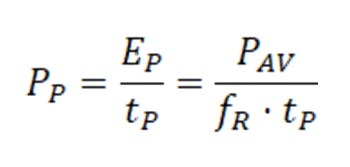
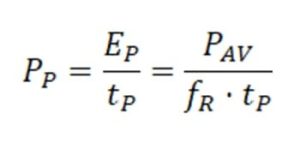
Peak power is one of the most important specifications when comparing pulsed lasers. A laser with only a few watts of average power can produce peak powers in the kilowatt or even hundreds-of-kilowatts range when that energy is concentrated into short nanosecond or picosecond pulses.
Understanding how average power, repetition rate, pulse energy, pulse duration, and pulse shape interact makes it easier to compare nanosecond lasers, picosecond lasers, and other pulsed sources for a specific application.
How Do You Calculate Laser Peak Power?
First calculate the energy contained in each pulse:
Epulse = Pavg / frep
where Pavg is average power and frep is pulse repetition rate.
For a simple square or flat-top pulse, peak power is:
Ppeak = Epulse / tpulse
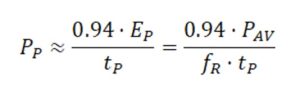
For real laser pulses, the exact peak power depends on the temporal pulse shape. A Gaussian pulse using FWHM pulse duration has a peak power of approximately 0.94 × Epulse / tFWHM.
How Pulse Shape Affect Peak Power
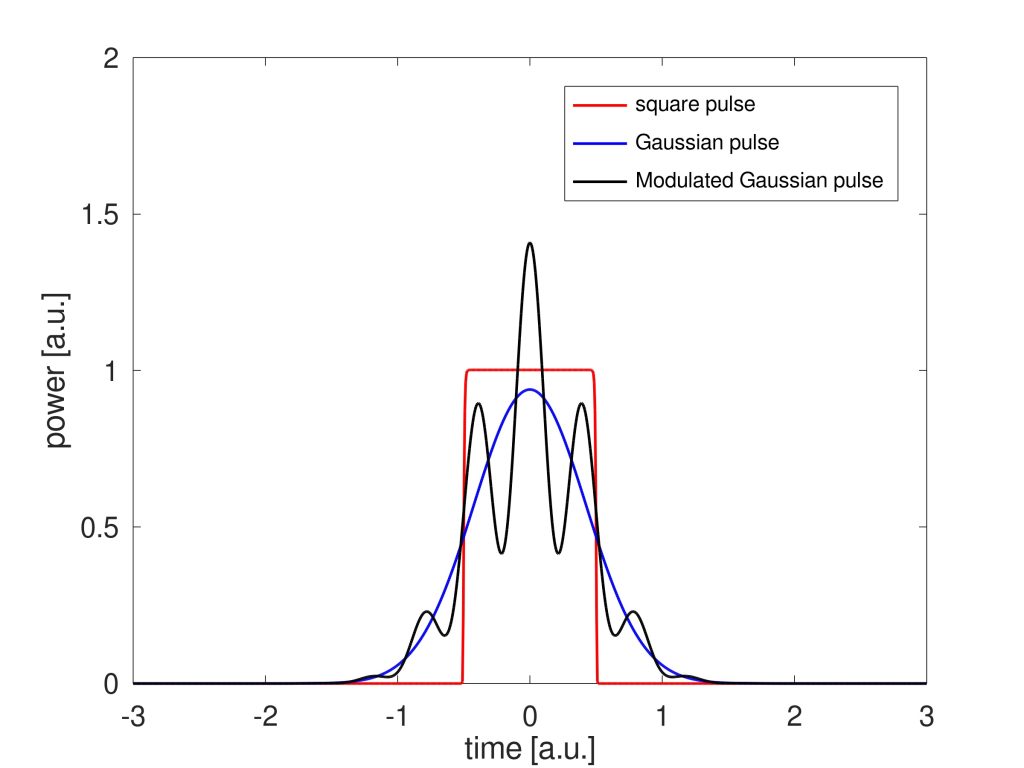
The simple relationship between pulse energy and pulse duration is exact for an ideal square pulse, but most laser pulses do not have a perfectly flat temporal profile. Real pulses typically rise to a maximum and then fall, so the pulse shape must be considered when a more precise peak-power value is required.
For a Gaussian temporal pulse, pulse duration is commonly specified as the full width at half maximum (FWHM). The corresponding peak power is approximately
Ppeak ≈ 0.94 × Epulse / tFWHM
The 0.94 factor accounts for the fact that the pulse energy is distributed across the Gaussian temporal profile rather than constrained in an ideal rectangular pulse.
Why Sub-Nanosecond Peak Power Can Be Harder to Estimate
For short-pulse Q-switched lasers, the measured temporal waveform may not always follow a smooth Gaussian envelope. Lasers operating with multiple longitudinal modes can exhibit fast intensity modulation caused by mode beating between the resonator modes.
If the detector and oscilloscope are fast enough to resolve those oscillations, the measured waveform can contain instantaneous peaks above the underlying pulse envelope. A slower measurement system may average those variations together.
For that reason, there is no universal correction factor that should be applied to every multimode or sub-nanosecond laser. When the exact instantaneous peak power is important, the measured temporal pulse shape and measurement bandwidth should be considered. For general product comparison, pulse energy divided by pulse duration, with an appropriate pulse-shape correction where known, remains a useful and consistent estimate.
Peak Power vs. Average Power: Wedge HF Example
The relationship between repetition rate, pulse energy, pulse duration, and peak power can be illustrated using the 1064 nm Wedge HF short-pulse DPSS laser.
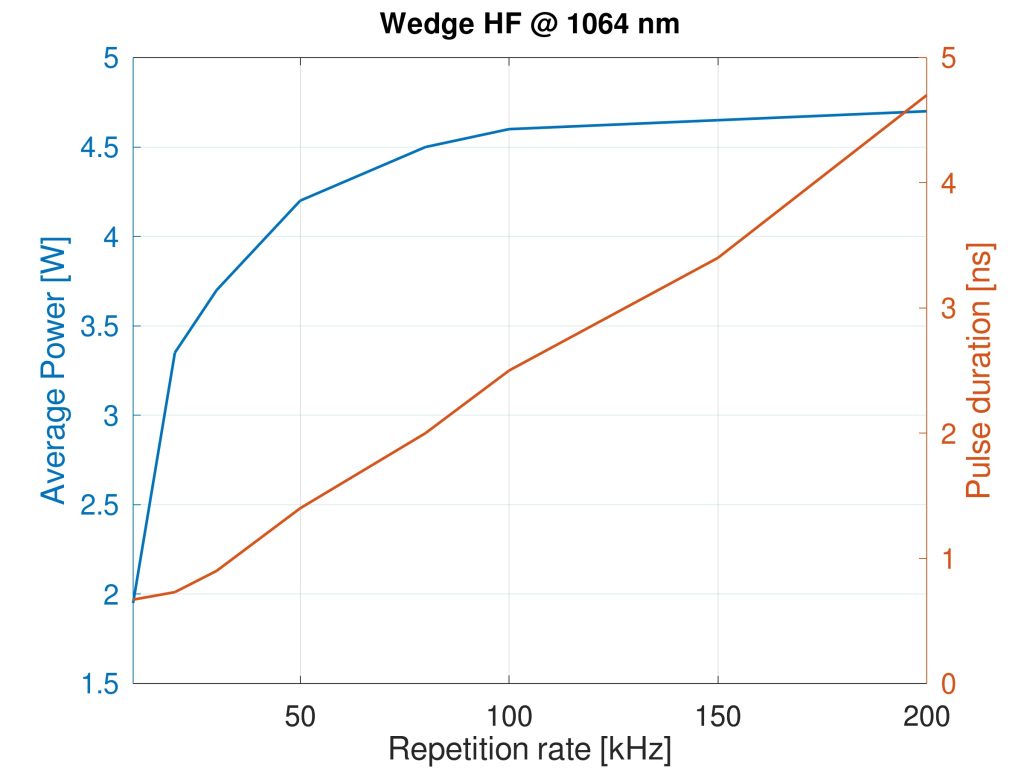
At approximately 100 kHz, an average power of about 4.6 W corresponds to a pulse energy of approximately 46 µJ:
4.6 W / 100,000 pulses/s ≈ 46 µJ per pulse
With a pulse duration of approximately 2.5 ns, the simple pulse-energy-to-duration calculation gives a nominal peak power of approximately 18 kW. If the pulse is treated as Gaussian using the 0.94 correction factor, the result is approximately 17 kW.

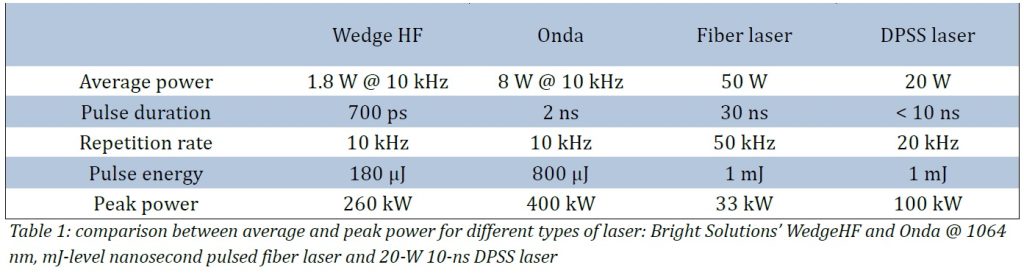
At a lower repetition rate, the pulse energy increases while the pulse duration becomes shorter. At approximately 10 kHz and 1.8 W average power, the pulse energy is about 180 µJ. With a pulse duration of approximately 700 ps:
Nominal peak power ≈ 257 kW
Gaussian-adjusted peak power ≈ 242 kW
This illustrates why average power alone does not describe the performance of a short-pulse laser. A source with lower average power can produce substantially higher peak power when its pulse energy is delivered over a much shorter time.
What Matters When Comparing Pulsed Lasers?
Peak power is important, but it should not be evaluated by itself. The appropriate pulsed laser depends on how wavelength, pulse energy, pulse duration, repetition rate, average power, beam quality, and focused spot size interact with the application.
For example, shorter pulse duration can increase peak power without increasing average power, while higher repetition rate may improve processing throughput but reduce the energy available in each pulse. Beam quality also affects how tightly the laser can be focused and therefore the peak intensity delivered to the target.
When comparing pulsed sources, define which parameters are actually fixed by the application and where tradeoffs are possible. RPMC can help compare nanosecond, sub-nanosecond, and picosecond laser options across multiple architectures and configurations.
Comparing nanosecond or sub-nanosecond laser options?
Send RPMC your wavelength, pulse energy or average power, pulse width, repetition rate, beam requirements, and application. We can help narrow the available pulsed-laser architectures and identify practical configurations.