 BUY NOW
 PowerMir
Quantum Cascade Laser (QCL), Spectrally Multimode, QCW, 4-9µm, up to 2W
Key Features:
- High-power QCW QCL source for 4-9 µm applications
- Spectrally multimode output up to 2 W, per configuration
- Chip, HHL package, OEM driver/module, or turnkey
- ITAR-free QCL technology
- Compact packages for defense, security, characterization, IR testing, OEM integration
- Driver, cooling, modulation, trigger, package options per configuration
Need help confirming a PowerMir configuration? Share your target wavelength, output power, pulse format/duty cycle, package preference, driver/cooling needs, and integration environment.
RPMC can help determine whether PowerMir, UniMir, or a custom mirSense path is the right starting point.

POPULAR CONFIGURATIONS:

The PowerMir series is a high-power, spectrally multimode quantum cascade laser platform for applications that require QCW output in the 4-9 µm range. PowerMir is a strong starting point when the project needs higher QCL output power, compact packaging, and a practical path toward HHL, OEM module, or turnkey system integration.
PowerMir is commonly considered for IR testing, defense/security research, detector validation, material characterization, countermeasure-related R&D, and OEM systems where wavelength, power, duty cycle, thermal control, and packaging constraints all affect the final configuration.
Start with PowerMir when your application depends on:
- High-power QCW QCL output in the 4-9 µm range
- Spectrally multimode QCL emission
- HHL, OEM module, chip-on-submount, or turnkey system options
- Compact integration with driver, cooling, modulation, and trigger requirements
- ITAR-free PowerMir technology, subject to project-specific export/compliance review
- IR testing, defense/security, material characterization, or OEM QCL integration needs
If your application instead requires narrow-linewidth DFB operation, molecule-specific sensing, or 10-19 µm LWIR spectroscopy, UniMir may be the better starting point. RPMC can help compare PowerMir and UniMir based on wavelength, output power, linewidth, package, driver, cooling, and integration requirements.
Technical Notes on PowerMir Configuration Paths
PowerMir is designed for high-power, spectrally multimode QCW QCL applications in the 4-9 µm range. Depending on the wavelength and configuration, PowerMir can support applications that require higher MWIR/LWIR optical power, compact packaging, and a practical path from laboratory evaluation to OEM system integration.
PowerMir configurations may include chip-on-submount options, HHL-packaged lasers, OEM driver/module systems, or turnkey platforms. HHL configurations can include thermal regulation and collimating optics, while OEM driver/module options can support integration needs such as driver control, modulation, synchronization, and system communication.
For applications with specific requirements for wavelength, output power, duty cycle, beam delivery, package format, driver control, cooling, or export/compliance review, RPMC can help compare available PowerMir configurations against the intended use case and integration environment.
PowerMir Technical Highlights
- Spectrally multimode QCW QCL architecture
- 4-9 µm wavelength range
- High-power output options, up to approximately 2 W depending on wavelength and configuration
- Chip, HHL package, OEM driver/module, and turnkey configuration paths
- HHL package options with thermal regulation and collimating optics
- OEM driver/module options for integration, modulation, synchronization, and system control
- Turnkey platform options for lab evaluation and testing
- ITAR-free PowerMir technology, with project-specific export/compliance requirements confirmed through RPMC
QCL Articles
MWIR & LWIR QCLs Enable Efficient & Cost-Effective Material Characterization
White Paper: Quantum Cascade Lasers (QCLs) for Infrared Countermeasures
PowerMir HHL Package
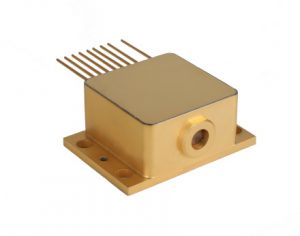
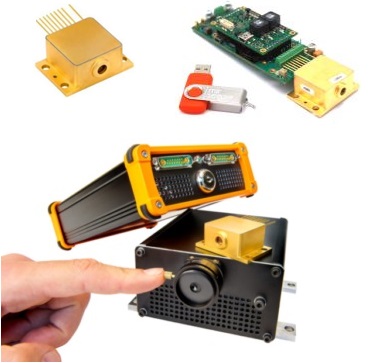
For clients who wish to purchase only the laser without the driving electronics, all of our laser wavelengths are available in a packaged version alone. Our standard offer is in an HHL package including the thermal regulation and a collimating lens. We are used to developing and supplying custom packages as well. For specific projects, mirSense can also supply QCL chips on submounts on demand.
PowerMir HHL Features:
- Standard high heat loads package (9-pins HHL) or custom package on request
- Integrated Peltier TEC cooler
- Integrated collimating lens (High beam quality, M²<1.5)
- Possibility of chips on submount delivery
- Optional circular beam with 2.5mrad divergence
PowerMir HHL Package with Driver (POEM system)
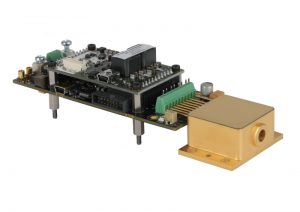
The PowerMir OEM system (POEM) is meant for customers who wish to integrate a QCL high-powered source inside their system (for example a DIRCM system). Each POEM is a compact light-weight and robust system made up of a packaged QCL laser plugged to a driving electronics board.
This board is embedded with unprecedented functionalities such as laser driver, complex programmable modulation schemes and of course full laser protection. The onboard firmware protects the laser from burning through temperature management of the TEC element. The customer can communicate with the board through MODBUS commands and a TTL trigger allows the customer to modulate each board with confidentiality. Several POEM systems can be combined to combine and increase the total optical output power.
PowerMir HHL Package with Driver Features:
- Compact stand-alone OEM product for system integration
- Powerful FPGA-based architecture
- MODBUS communication for system integration and user-friendly PC software for configuration and tests
- External TTL for synchronization
- Cost effective for series-productions
PowerMir Turnkey HHL Package with Driver
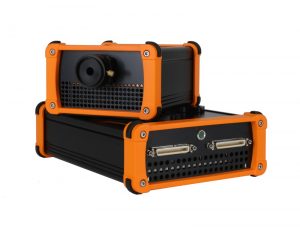
For lab experiments, we offer a plug-and-play easy to use turnkey system that includes laser heads, a driver and the cooling mechanism as well as a user-friendly PC software. In order to accommodate you in your future projects, the mirSense turnkey platform is very modular. It’s able to control simultaneously 2 different laser heads (with different or identical wavelengths).
PowerMir Turnkey Features:
- Plug-and-play system perfect to use inside a lab
- Stand alone system including: laser head, driver, heat exchanger
- User-friendly PC software allows users to:
- Turn ON/OFF the laser
- Easily change the operating mode (power, modulation)
- External TTL for synchronization
- Red laser beam to facilitate alignment
Benefits:
- High-power QCW QCL output: Supports applications where higher MWIR/LWIR optical power is required.
- Multiple configuration paths: Choose from chip, HHL, OEM driver/module, or turnkey system options depending on integration stage.
- OEM integration support: Driver, cooling, TTL trigger, modulation, and control options can support embedded-system development.
- ITAR-free PowerMir technology: Can simplify sourcing for some programs, but export/compliance requirements should be confirmed for each project.
- Lab-to-system flexibility: Turnkey systems can support lab evaluation, while HHL and OEM options support integration paths.
- RPMC selection help: RPMC can help compare wavelength, output power, duty cycle, package, and driver requirements before quoting.
Ready to confirm a PowerMir configuration?
PowerMir is a strong starting point when your application requires high-power QCW QCL output in the 4-9 µm range, compact packaging, and a path toward HHL, OEM module, or turnkey integration.
Send RPMC the details below and we can help confirm whether PowerMir, UniMir, or a custom mirSense configuration is the right fit.
- Application or use case
- Target wavelength or wavelength range
- Required output power
- Pulse format, duty cycle, or QCW requirements
- Timeline and Quantity
- Package preference: chip, HHL, OEM module, turnkey
- Driver, cooling, modulation, or TTL trigger needs
- Lab, field, defense/security, or OEM environment
- Beam delivery or integration constraints
- Export or compliance considerations
RPMC will help compare requirements and confirm whether PowerMir, UniMir, or a custom QCL configuration is the best fit.
| Wavelength (nm) | |
|---|---|
| Description | Quantum Cascade Laser (QCL), Spectrally Multimode, QCW, 4-9µm, up to 2W |
| Type |