 BUY NOW
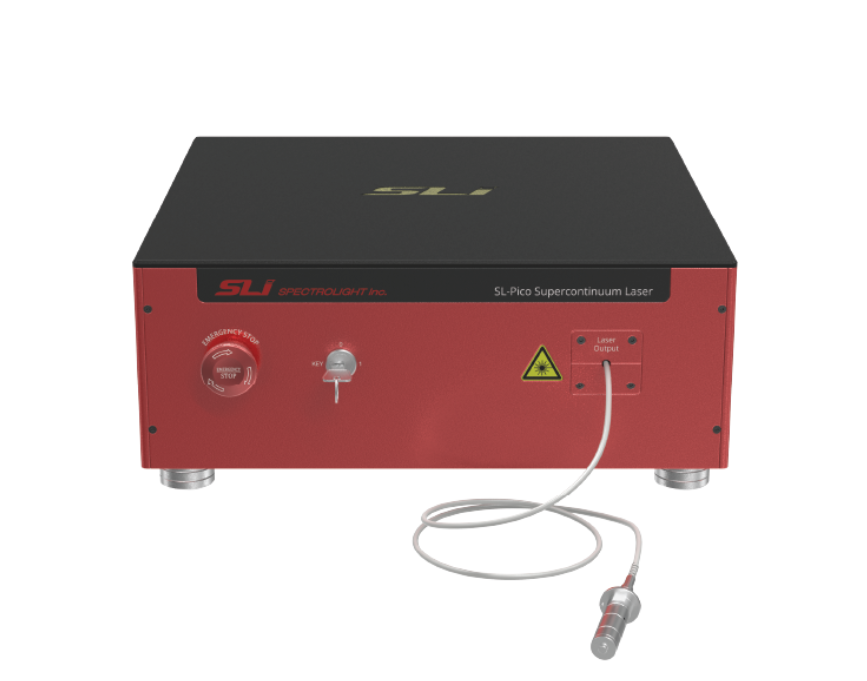
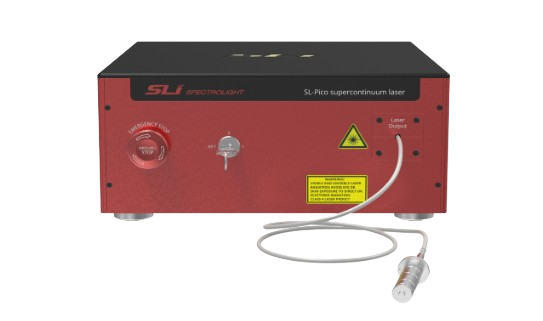
 SL-Pico
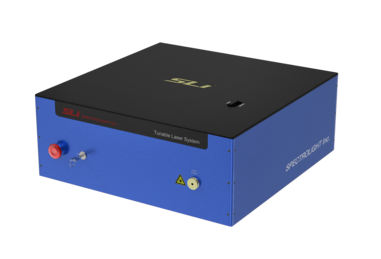
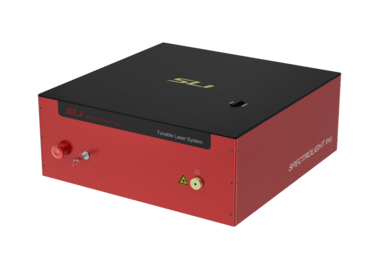
410–2400 nm picosecond supercontinuum white-light source with up to 8 W average power and fixed or variable repetition-rate options up to 200 MHz.
Key Features:
- Broadband visible-to-SWIR output from 410–2400 nm, depending on configuration
- Up to 8 W total avg. power w/ VIS output options by config.
- Fixed PRR @ 5, 10, 20, 40, or 80 MHz | Variable PRR from 10 kHz to 40 or 200 MHz
- ps pulse-width options: <50 ps & <300 ps models
- Stable, plug-and-play source for spectroscopy, microscopy, imaging, OCT, inspection
- Optional wavelength-selector for tunable VIS, IR, SWIR, or custom spectral ranges
Choose from seven base SL-Pico configurations w/ various wavelength ranges, output powers, pulse widths, fixed or variable rep-rate options.
If you do not see the exact configuration you need, contact RPMC for help matching the model to your application.
POPULAR CONFIGURATIONS:
Picture |
Part Number |
Part Description |
Datasheet |
|
|---|---|---|---|---|
|
SL10 |
Supercontinuum laser, 450-2400 nm white output, 1 W total avg. power (100 mW – VIS), <300 ps pulse width, 5 MHz rep rate |

|
Get Quote |
|
|
SLM10 |
Supercontinuum laser, 410-2400 nm white output, 1 W total avg. power (250 mW – VIS), <50 ps pulse width, 10 MHz rep rate |
|
Get Quote |
|
|
SLM20 |
Supercontinuum laser, 410-2400 nm white output, 2 W total avg. power (500 mW – VIS), <50 ps pulse width, 20 MHz rep rate |
|
Get Quote |
|
|
SLM40 |
Supercontinuum laser, 410-2400 nm white output, 4 W total avg. power (1 W – VIS), <50 ps pulse width, 40 MHz rep rate |
|
Get Quote |
|
|
SLM35V |
Supercontinuum laser, 410-2400 nm white output, 3.5 W total avg. power (1 W – VIS), <50 ps pulse width, 10 kHz – 40 MHz rep rate (adjustable) |
|
Get Quote |
|
|
SL80V |
Supercontinuum laser, 430-2400 nm white output, 8 W total avg. power (1 W – VIS), <300 ps pulse width, 10 kHz to 200 MHz rep rate (adjustable) |
|
Get Quote |
|
|
SLM70 |
Supercontinuum laser, 410-2400 nm white output, 7 W total avg. power (2 W – VIS), <50 ps pulse width, 80 MHz rep rate |
|
Get Quote |
Overview: SL-Pico Picosecond Supercontinuum Laser
The Spectrolight SL-Pico is a picosecond pulsed supercontinuum laser platform for applications that need stable, broadband visible-to-SWIR output from a single white-light source. With configurations covering approximately 410–2400 nm, SL-Pico supports spectroscopy, microscopy, hyperspectral and multispectral imaging, OCT/interferometry, semiconductor inspection, optical characterization, metrology, and calibration.
SL-Pico was highlighted in the 2024 Review of Spectroscopic Instrumentation product review.
SL-Pico is available in multiple power classes and architectures, including SLM mode-locked models and SL gain-switched models. Fixed and variable repetition-rate options allow users to select a configuration based on wavelength range, average power, pulse width, timing requirements, and detector or system synchronization needs.
RPMC can help compare SL, SLM, and variable-repetition-rate configurations, and can also help determine whether your application needs full broadband output or a tunable supercontinuum laser system using Spectrolight wavelength-selection technology.
Why Choose the SL-Pico Supercontinuum Laser?
SL-Pico is designed for users who need a stable, broadband picosecond white-light source that can support multiple wavelength-dependent measurements from a single laser platform. Instead of selecting separate sources for different spectral regions, SL-Pico provides visible, NIR, and SWIR coverage in configurable power and repetition-rate formats.
Dual Laser Architectures
Mode-locked and gain-switched architectures tailored to your application
Broadband Spectral Coverage
Continuous output from 410 nm to 2400 nm (VIS to SWIR)
Flexible Power Options
Multiple power classes, from compact entry-level to high-power models
Versatile System Configuration
Fixed and variable repetition rate options for diverse application needs
SLM Series
Mode-Locked Supercontinuum Laser
- Short Pulse Duration: <50 ps
- Spectral Range: 410-2400 nm
- Exceptional Spectral Flatness & High-Power Stability
- Scalable Power Classes & Rep. Rates
Ideal for applications requiring uniform spectral power distribution, high stability, and precise visible-spectrum perfromance.
SL Series
Gain-Switched Supercontinuum Laser
- Cost-Effective High-Power Solution
- Spectral Range: 430/450-2400 (Pulse Duration: <300 ps)
- High Total Output Power & Enhanced SWIR Performance
- Scalable Power Classes & Rep. Rates
Ideal for budget-conscious application requiring high total power and robust SWIR-band performance.
Picosecond Pulse Width
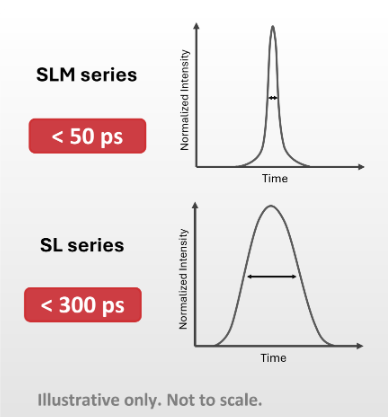
Optimized picosecond pulse durations specific to each architecture.
Excellent Spatial Beam Profile
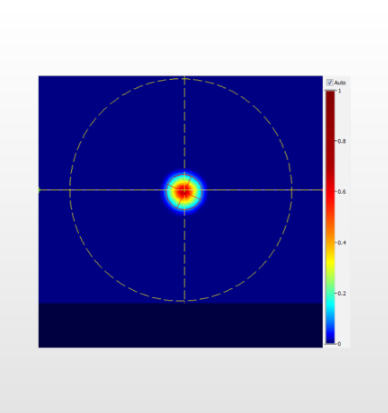
High-quality, near-circular beam profile for optimal focusing.
TTL/NIM Synchronization
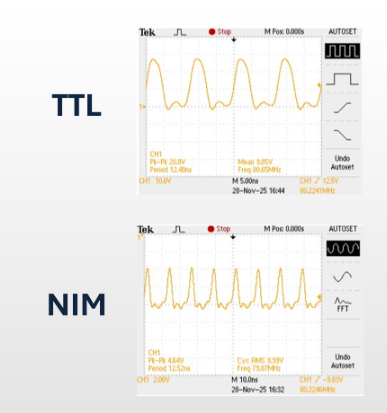
Dual simultaneous TTL and NIM triggers for flexible synchronization.
Fixed or variable repetition-rate options
SL-Pico models are available with fixed MHz repetition rates or variable repetition-rate configurations, allowing users to match the source to detector timing, synchronization requirements, or experimental setup constraints.
Upgradeable path to tunable output
For applications that need wavelength-selectable illumination instead of full broadband output, SL-Pico can be paired with Spectrolight wavelength-selection technology to support tunable VIS, IR, SWIR, or custom spectral ranges.
Which SL-Pico Configuration Fits Your Application?
SL-Pico is available in multiple configurations with different wavelength ranges, output powers, pulse widths, and repetition-rate formats. The best starting point depends on whether your application prioritizes broadband power, shorter pulse width, repetition-rate flexibility, detector synchronization, or tunable wavelength selection.
| Configuration | Best Fit | Typical Selection Factors | Example Models |
|---|---|---|---|
| SL Series | Gain-switched supercontinuum output | Good fit when high broadband output power and variable repetition-rate options are important. SL models may be useful for applications that need a flexible broadband white-light source with higher total average power. | SL10, SL80V |
| SLM Series | Mode-locked picosecond supercontinuum output | Good fit when shorter pulse width, stable fixed repetition rate, and strong visible/NIR/SWIR broadband output are important. | SLM10, SLM20, SLM40, SLM70 |
| SLMV Series | Mode-locked output with variable repetition-rate flexibility | Good fit when the application needs picosecond pulses and adjustable repetition rate for synchronization, timing control, or compatibility with different detectors and measurement setups. | SLM35V |
Not sure which model is the right starting point? Share your wavelength range, average power needs, pulse-width requirements, repetition-rate requirements, timing/synchronization needs, and application with RPMC.
Need Tunable Output Instead of Full Broadband Output?
SL-Pico provides broadband white-light supercontinuum output. If your application needs wavelength-selectable output, controlled bandwidth, or tunable illumination over a specific spectral region, SL-Pico can be paired with Spectrolight wavelength-selection technology.
This approach allows users to extract selected center wavelengths and bandwidths from the broadband 410–2400 nm spectrum, combining the flexibility of a tunable laser with the power and coverage of a supercontinuum source.
For tunable-output applications, RPMC can help determine whether SL-Pico alone, SL-Pico with wavelength selection, TLS-Blue, TLS-Red, or a custom Spectrolight configuration is the better fit.
Questions to Answer Before Choosing an SL-Pico Model
Need help choosing between SL, SLM, SLMV, fixed repetition-rate, variable repetition-rate, broadband, or tunable-output configurations? Send RPMC as many of the following requirements as possible:
- Required wavelength range
- Whether you need full broadband output or tunable wavelength selection
- Required average power or visible/NIR/SWIR power
- Pulse-width requirements
- Fixed or variable repetition-rate requirements
- Timing, triggering, or synchronization needs
- Detector, camera, spectrometer, or optical-system compatibility requirements
- Application: spectroscopy, microscopy, OCT, hyperspectral imaging, inspection, calibration, LiDAR / remote-sensing research, etc.
- Lab, OEM, industrial, or fielded integration environment
- Budget, timeline, and configuration constraints
Send your requirements to RPMC and we will help narrow the SL-Pico options and identify whether a standard configuration, tunable Spectrolight system, or custom approach is the best fit.
Additional SL-Pico Benefits:
- Easy to Setup: Plug & Play system requires no alignments or adjustments allowing instant application
- Easily Upgradable: Connecting to the optional Flexible Wavelength selector is simple and allows for full tunability within a selected range: VIS, IR, SWIR, or choose a custom range
- Replace Old Technology: While older, simpler lamp-based light sources are relatively cheap, the advanced precision, collimation, and coherence of tunable laser-based light sources can help tackle modern applications with excellent results (when combined with Flexible Wavelength Selector)
Applications for SL-Pico Picosecond Supercontinuum Lasers
SL-Pico can support a wide range of research, industrial, and OEM applications that require broadband picosecond-pulsed output. Application suitability depends on the selected model, wavelength range, power level, pulse width, repetition rate, and system configuration.
Hyperspectral & Multispectral Imaging
Broadband illumination can support hyperspectral and multispectral imaging, hyperspectral camera testing, machine vision, spectral image calibration, and wavelength-dependent imaging research.
Microscopy & Bio-Imaging
SL-Pico may support fluorescence microscopy, confocal microscopy, light-sheet microscopy, FLIM, time-resolved microscopy, TCSPC, biomedical imaging research, retinal imaging research, and multispectral microscopy.
OCT & Interferometry
Broadband output can support OCT research, spectral-domain OCT development, white-light interferometry, spectral interferometry, chromatic confocal sensing, and optical path-length measurement.
LiDAR & Remote-Sensing Research
SL-Pico may be useful for broadband LiDAR and remote-sensing research where teams need to explore wavelength-dependent target response, detector behavior, receiver performance, timing, or spectral measurement paths.
For white-light LiDAR research, the broadband picosecond source can support prototype and test setups used to evaluate how wavelength, target response, detector behavior, receiver design, timing, and measurement architecture work together before a final system architecture is selected.
Spectroscopy & Optical Characterization
SL-Pico can support absorption spectroscopy, transmission and reflectance measurements, fluorescence spectroscopy, photoluminescence, photoluminescence excitation, broadband spectroscopy, pump-probe measurements, and spectral responsivity testing.
Semiconductor, Display & Industrial Inspection
SL-Pico may support semiconductor and wafer inspection, micro-LED and LED inspection, photodetector characterization, image-sensor testing, camera calibration, optical component QC, thin-film inspection, and surface-defect analysis.
Metrology, Calibration & Detector Testing
SL-Pico can support spectrometer calibration, detector responsivity calibration, wavelength calibration, optical filter characterization, reflectance and transmittance measurement, color measurement, and optical test-system development.
Related Spectrolight Products
SL-Pico is the broadband picosecond supercontinuum source platform. For applications that need wavelength-selectable output, controlled bandwidth, or tunable illumination, consider related Spectrolight tunable laser systems.
- TLS-Blue Fixed-Bandwidth Tunable Picosecond Laser: Broadband tunable picosecond laser system for wavelength-selectable output over selected spectral regions.
- TLS-Red Adjustable-Bandwidth Tunable Picosecond Laser: Tunable supercontinuum laser system for applications requiring wavelength and bandwidth flexibility.
- Spectrolight Manufacturer Page: View additional Spectrolight light sources, tunable laser systems, and wavelength-selection options available through RPMC.
SL-Pico Supercontinuum Laser FAQs
Below are common questions about SL-Pico wavelength coverage, source architectures, repetition-rate options, tunable-output configurations, and application fit.
What is the SL-Pico used for?
SL-Pico is a broadband picosecond supercontinuum white-light source for applications such as spectroscopy, microscopy, hyperspectral and multispectral imaging, OCT and interferometry research, optical characterization, semiconductor inspection, metrology, calibration, and detector or camera testing.
What wavelength range does SL-Pico cover?
Depending on configuration, SL-Pico models provide broadband output across approximately 410-2400 nm. Some models begin at 410 nm, while others are listed from 430 nm or 450 nm to 2400 nm.
What is the difference between SL, SLM, and SLMV models?
SL models use a gain-switched architecture, while SLM models use a mode-locked architecture with fixed repetition rates. SLMV models combine mode-locked picosecond output with variable repetition-rate flexibility. The right starting point depends on required broadband power, pulse width, repetition rate, timing, and synchronization needs.
When should I choose a variable repetition-rate model?
A variable repetition-rate model may be useful when the laser needs to match detector timing, camera acquisition, lock-in detection, time-resolved measurement setups, or synchronization requirements in an optical system.
Can SL-Pico be used as a tunable laser source?
SL-Pico is a broadband supercontinuum source. When paired with Spectrolight wavelength-selection technology, selected wavelength regions and bandwidths can be extracted from the broadband output. For applications that require tunable rather than full broadband output, RPMC can help compare SL-Pico, TLS-Blue, TLS-Red, and custom Spectrolight configurations.
How do I choose the right SL-Pico model?
Start with the required wavelength range, average power, pulse width, repetition rate, whether the application needs full broadband or wavelength-selected output, and any detector or system synchronization requirements. RPMC can help compare the available SL-Pico configurations.
Can SL-Pico be used for LiDAR or remote-sensing research?
SL-Pico may be useful for broadband LiDAR and remote-sensing research when the goal is to study wavelength-dependent target response, detector behavior, receiver performance, spectral measurement paths, or prototype system architectures. Its picosecond broadband visible-to-SWIR output can provide more spectral flexibility than a single-wavelength source.
For fielded LiDAR systems, airborne platforms, bathymetry, or ruggedized remote-sensing systems, the full source, receiver, timing, packaging, and environmental requirements should be reviewed before selecting a laser. RPMC can help determine whether SL-Pico is appropriate for the research setup or whether another laser source is a better fit.