
 BUY NOW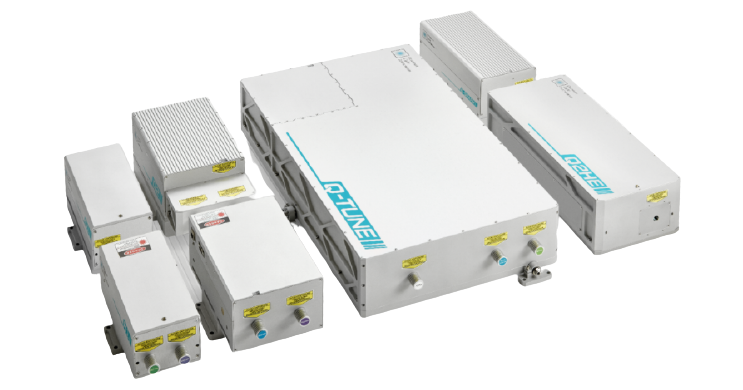
High-energy nanosecond lasers are often selected around a few practical constraints: wavelength access, pulse energy, repetition rate, cooling infrastructure, footprint, and integration complexity. For labs and OEM systems where water cooling, bulky power supplies, or frequent maintenance create problems, QLI’s air-cooled DPSS platforms can be a strong fit.
QLI offers both tunable OPO-based systems and fixed-wavelength Q-switched lasers, giving technical buyers several paths depending on whether the application needs broad wavelength flexibility, maximum pulse energy, harmonic generation, short nanosecond pulses, or specialized pulse timing.
RPMC can help narrow the options based on your wavelength range, pulse energy, repetition rate, beam delivery, control interface, and integration constraints, especially when the right answer is not obvious from a datasheet alone.
Quick Selection Guide: Which QLI Platform Should You Consider?
| If your application needs… | Consider… | Why it may fit |
|---|---|---|
| Broad wavelength tuning for spectroscopy, photoacoustics, or research flexibility | Q-TUNE family | Tunable OPO-based platforms provide wavelength flexibility when a fixed wavelength is too limiting. |
| IR wavelength access | Q-TUNE-IR | A fit for applications that require extended infrared tuning beyond the standard visible or near-IR range. |
| Higher average power or higher repetition-rate tunable operation | Q-TUNE-HR | Useful when tunability is still required, but throughput or repetition rate becomes a more important design factor. |
| A compact fixed-wavelength nanosecond source | Q1 or Q2 | A simpler path when the application does not require wavelength tuning and a fixed DPSS laser can meet the requirement. |
| Higher fixed-wavelength pulse energy | Q2HE | Designed for applications where pulse energy is the primary driver and tunability is not required. |
| Double-pulse operation or controlled pulse separation | Q-DOUBLE | A specialized option for applications that benefit from two precisely timed pulses. |
| Built-in wavelength conversion | Q-SHIFT | Helpful when harmonic generation or shifted output wavelengths are needed in a compact integrated platform. |
| Shorter nanosecond pulses | Q-SPARK | A fit when pulse duration is a key performance requirement and shorter nanosecond pulses are preferred. |
Tunable vs. Fixed-Wavelength Nanosecond Lasers
One of the first questions to answer is whether the application truly needs wavelength tuning. Tunable systems are valuable when the experiment or process depends on wavelength-dependent absorption, excitation, or material response. This is common in spectroscopy, photoacoustic imaging, fluorescence excitation, and other research-driven applications where flexibility can be more important than simplicity.
Fixed-wavelength lasers are often the better fit when the required wavelength is already known and stable. They can simplify integration, reduce unnecessary complexity, and provide a more direct path for OEM or production-oriented systems where repeatability, footprint, and ease of operation matter more than wavelength flexibility.
In practice, the right choice depends on the balance between wavelength flexibility, pulse energy, repetition rate, beam quality, cooling limits, footprint, and control requirements.
Where Air-Cooled Nanosecond Lasers Can Help
Air-cooled nanosecond lasers are especially useful when the application needs meaningful pulse energy but cannot justify the added size, infrastructure, or maintenance associated with water-cooled systems. For many labs and OEM integrations, eliminating water cooling can simplify setup, reduce service concerns, and make the laser easier to integrate into a compact system.
This can be valuable in applications such as spectroscopy, photoacoustic imaging, LIBS, LIDAR, fluorescence excitation, PIV, materials research, and other use cases where compact nanosecond performance is required. Final product fit still depends on the specific wavelength, pulse energy, repetition rate, beam delivery, and environmental requirements.
Good Fit / Not Always the Right Fit
QLI air-cooled nanosecond lasers may be a good fit when:
- You need high-energy nanosecond pulses in a compact platform.
- You want to avoid water cooling or reduce system complexity.
- You need tunable output for wavelength-dependent experiments.
- You need a fixed-wavelength DPSS laser for a known application requirement.
- You need options for harmonic generation, wavelength shifting, or specialized pulse timing.
- You are integrating into a lab setup, prototype system, or OEM instrument where footprint and usability matter.
Another laser architecture may be a better fit when:
- You need ultrafast pulse durations rather than nanosecond pulses.
- You need repetition rates beyond the operating range of the selected QLI platform.
- Your application requires a fiber laser architecture.
- You need a fully qualified regulated system without additional application and compliance review.
- You are unsure whether wavelength tunability, pulse energy, or repetition rate should be the main selection driver.
If these laser platforms aren’t the right fit: Don’t hesitate to reach out to us at [email protected] or Contact Us with the button below to discuss your requirements and best-fit options for your application:
Key Selection Factors to Review
Before selecting a QLI platform, it helps to define the main technical constraints as clearly as possible. The most important questions usually include:
- Wavelength: Do you need one fixed wavelength, multiple wavelengths, or broad tunability?
- Pulse energy: What minimum pulse energy is required at the target wavelength?
- Repetition rate: Is the application limited by pulse energy, throughput, or timing?
- Pulse width: Does the process or measurement require a shorter nanosecond pulse?
- Beam delivery: Do you need free-space output, fiber coupling, or a specific beam format?
- Cooling: Is air cooling required because of space, service, or integration constraints?
- Controls: Do you need browser-based control, API access, remote operation, or OEM integration support?
- Accessories: Will the system require harmonic generation, energy monitoring, fiber coupling, or other add-ons?
How RPMC Can Help Narrow the Options
QLI’s product family includes several platforms with overlapping capabilities. That flexibility is useful, but it can also make selection more difficult if you are comparing tunable systems, fixed-wavelength systems, harmonic options, pulse energy limits, and integration requirements at the same time.
RPMC helps technical buyers compare standard and configurable laser options based on the actual application requirements, not just the highest number on a datasheet. Our team can help review your wavelength, pulse energy, repetition rate, pulse width, beam delivery, footprint, and control needs to identify which QLI platform is most likely to fit.
This is especially useful for buyers who are still deciding between a tunable OPO-based system and a fixed-wavelength DPSS laser, or for teams that need to confirm whether an air-cooled platform can meet the required performance without adding unnecessary complexity.
Need Help Choosing a QLI Nanosecond Laser?
Tell us your target wavelength or tuning range, pulse energy, repetition rate, pulse width, beam delivery requirements, cooling limits, footprint constraints, and whether you need harmonic generation, fiber coupling, energy monitoring, or API control.
RPMC can help down-select the right QLI platform for your application and determine whether a standard, configurable, or application-specific option is the best fit.
A Closer Look at QLI’s Air-Cooled Lasers:
Why QLI’s Air-Cooled High-Energy Lasers Stand Out:
- True water-free operation: runs on air cooling only (15–30 °C ambient)
- Low power consumption: typically 50–150 W
- Compact & lightweight: easy lab or OEM integration
- >2 Gshot pump-diode lifetime
- Turnkey control: built-in web server (Ethernet), no software install required, full API available
- Microprocessor self-optimization and calibration
Wavelength-Tunable Lasers: Q-TUNE Family
Integrated diode-pumped laser + OPO in one air-cooled housing.
| Series | Tuning Range | Max Pulse Energy | Rep Rate | Linewidth | Pulse Width | Key Strengths |
| Q-TUNE | 210–2300 nm (SH option) | Up to 8 mJ (VIS), pump up to 100 mJ | up to 100 Hz | <6 cm⁻¹ | <5 ns | Time-resolved spectroscopy, LIFS |
| Q-TUNE-G | 680–2300 nm | Up to 11 mJ (NIR) | up to 100 Hz | 10–15 cm⁻¹ (20-200 cm⁻¹ option) | <4 ns | Photoacoustic imaging & microscopy |
| Q-TUNE-IR | 1380–4500 nm | >16 mJ peak | up to 100 Hz | <10 cm⁻¹ (~200 cm⁻¹ option) | 3–4 ns | IR & various spectroscopy |
| Q-TUNE-HR | 680–2100 nm | Up to 4 W avg. power (NIR) | up to 100 kHz | 20–100 cm⁻¹ | 5–7 ns | IR & various spectroscopy |
Common Features Across Q-TUNE Series:
- Hands-free automated tuning
- Separate output ports for pump wavelengths
- Optional air-purging for UV/deep-UV optics longevity
- Motorized attenuators, fiber coupling, energy monitors, and compact spectrometers available
- All electronics integrated – only a small mains adapter needed
Fixed-Wavelength High-Energy Q-Switched Lasers
For applications that don’t require tunability but demand maximum energy or compactness:
| Series | Key Feature | Max Pulse Energy | Rep Rate | Pulse Duration | Best For |
| Q1 | Ultra-compact | Up to 40 mJ | up to 50 Hz | 7–10 ns | LIBS, LIF, metrology |
| Q2 | Versatile workhorse | Up to 80 mJ | up to 100 Hz | 5–10 ns (<3 ns option) | LIDAR, ablation, spectroscopy |
| Q2HE | Highest energy air-cooled | Up to 200 mJ | model dependent | <7 ns | High-energy industrial & scientific |
All models support harmonic generation (up to 5th harmonic, down to 211–213 nm) via attachable or stand-alone H1 / H-SMART generators.
Comparison: Tunable vs Fixed-Wavelength Systems
- Choose Q-TUNE family when you need flexible wavelength access (spectroscopy, photoacoustic imaging, gas analysis, etc.).
- Choose Q1/Q2/Q2HE when you need maximum pulse energy, higher repetition rates, or the simplest setup at a fixed wavelength (LIBS, LIDAR, ablation, PLD).
- Choose Q-SHIFT, Q-SPARK, or Q-DOUBLE when you have specialized pulse format or wavelength-shifting requirements that standard fixed-wavelength models don’t fully address.
All share the same core advantages: fully air-cooled, reliable, low maintenance, and web-browser control.
Specialized Fixed-Wavelength High-Energy Lasers
QLI also offers several specialized models built on the same air-cooled platform for targeted performance requirements:
| Series | Key Features | Max Pulse Energy | Rep Rate | Pulse Duration | Primary Applications |
| Q-SHIFT | Built-in nonlinear wavelength conversion | Model-dependent | up to 100 Hz | 2-5 ns | Convenient access to visible wavelengths |
| Q-SPARK | Short-pulse variant | Model-dependent | up to 100 Hz | Short ns (<5 ns typical) | Applications requiring faster pulses |
| Q-DOUBLE | Double-pulse output | Up to 80 mJ per pulse | up to 100 Hz | 5-10 ns | Pump-probe experiments, LIBS, photoacoustics |
Accessories & Integration Options
QLI provides a complete ecosystem to customize performance:
- Motorized Attenuators: precise, remote-controlled pulse energy control
- Pulse Energy Monitors: real-time analog/digital output for closed-loop operation or data logging
- Fiber Couplers: efficient coupling into optical fibers (UV, VIS, NIR, IR versions available)
- Air-Purging Units: essential for long-term UV and deep-UV optics lifetime
- Harmonic Generators: H1 (for Q1), SHG (attachable for Q2), H-SMART (stand-alone automated with up to 3 output ports)
- Additional options: compact spectrometers, baseplates, wireless adapters, and custom configurations
Applications for High-Energy DPSS Lasers
- Time-resolved and nonlinear laser spectroscopy (LIFS, etc.)
- Photoacoustic imaging & microscopy
- Infrared spectrophotometry, cavity ring-down, gas spectroscopy
- LIDAR and remote sensing
- Laser-induced breakdown spectroscopy (LIBS)
- Laser ablation, marking, scribing
- Micromachining
- Metrology and confocal microscopy
- Pulsed laser deposition (PLD)
- Medical & defense applications
Need a specific configuration? Reach out to [email protected] or Contact Us with the button below: