
 BUY NOW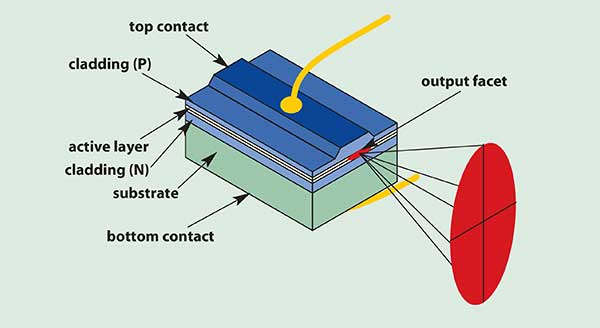
What Is Gain Threshold?
For any laser to function, there must be more gain inside the laser cavity than loss. The gain threshold is the point at which the laser gain becomes large enough to overcome the cavity loss, enabling lasing and optical output power.
While simple in theory, the concept of gain threshold can be particularly challenging to understand with diode lasers. In this post, we explore laser diode gain threshold, including the causes of cavity loss and the fundamental mechanisms behind optical amplification and gain in the diode material.
Population Inversion in Semiconductor Materials
Direct bandgap semiconductor materials can function as both optical emitters (lasers and LEDs) and optical absorbers (photodetectors). The key difference lies in whether the material is in a state of population inversion.
Population inversion occurs when there are more electrons in the conduction band than in the valence band. In this state, the material produces stimulated emission (gain). Without population inversion, the material acts as an absorber.
Achieving Population Inversion with Quasi-Fermi Levels
In semiconductors, the Fermi level normally lies in the middle of the bandgap, preventing population inversion under equilibrium conditions. However, injecting a sufficiently large current across the p-n junction creates a quasi-equilibrium state that splits the Fermi level into two quasi-Fermi levels. This decouples electron and hole densities.
Once the quasi-Fermi levels are established, the electron density in the conduction band becomes primarily a function of drive current (and to a lesser extent temperature). As a result, population inversion — and thus gain — becomes directly proportional to the injected current.
The Light-Current (L-I) Curve and Threshold Current
The image below shows the Light-Current (L-I) curve for an 830 nm multimode laser diode. After a minimum threshold current is reached, output power increases linearly with drive current.
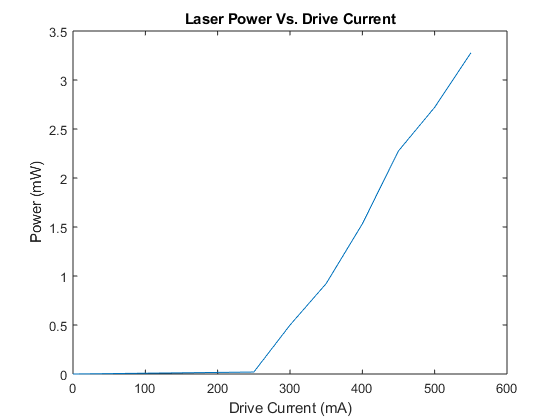
As current increases, the Fermi level splits, achieving population inversion and creating gain. Once gain reaches the threshold, the diode begins to lase. This plot clearly demonstrates the presence of gain threshold.
Cavity Losses in Laser Diodes
The primary source of loss in any laser is the reflectivity of the mirrors in the resonator cavity. The loss due to each mirror is proportional to the natural log of the inverse of its reflectivity. Higher mirror reflectivity means lower total loss and therefore a lower gain threshold.
Semiconductor materials have a high refractive index, so each cleaved facet naturally acts as a partially reflective mirror (~32% reflectivity). This gives the laser diode a built-in resonator capable of lasing without external optics.
For higher-power applications, the rear facet is typically coated with a high-reflectivity (HR) dielectric mirror (>90% reflectivity). This dramatically reduces the gain threshold while increasing useful output power from the front facet (output coupler).
Other losses (scattering, absorption, defects) exist but are typically much smaller than mirror loss and can often be ignored for first-order analysis.
The Role of Gain Medium Size
The size of the gain medium also plays a key role. Larger gain regions contain more electrons available to generate photons. This is why high-power laser diodes are physically larger than low-power ones.
The Gain Threshold Equation
Combining mirror losses, internal losses, and cavity length yields the threshold gain equation:
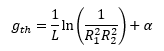
Where:
• gth = threshold material gain
• a = internal losses (scattering, absorption, etc.)
• L = cavity length
• R = facet reflectivity (assuming symmetric facets)
Summary and Key Takeaways
Understanding the relationship between gain mechanisms in the semiconductor and loss mechanisms in the built-in resonator cavity provides a complete picture of laser diode gain threshold.
RPMC Lasers has over 30 years of experience matching the ideal diode laser for your application. From standard, off-the-shelf laser diodes to many configurable products to endless customization options for packaging, integrated optics (including all of the designs discussed above) and much more. See our full selection of Laser Diodes, Contact Us with the button below, or email us at [email protected]!
Have questions?