
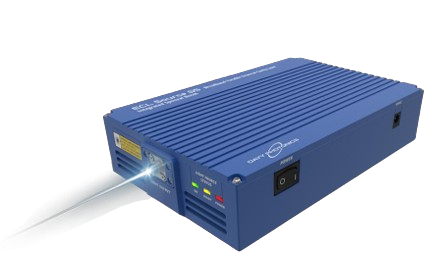
ISB5

Laser Diode, Turnkey, Narrow Linewidth, CW, Center wavelength option 785-1680nm, >10 mW per wavelength

Key Features:

  • Wavelengths from 785-1680nm
  • 5-80 nm tunability (by model)
  • >10 mW fiber-coupled output power (per wavelength)
  • Full-spectrum tuning speed up to 10 Hz for continuous tuning
  • FWHM: 0.1-1 nm (by model)
  • Communication: USB, RS-232
  • Integrated broadband dual-stage isolator
  • User-friendly GUI, Custom API available for test automation

There are many different configurations, choices for center wavelength, and other options. Get help selecting the right configuration for you!

Need Quantities? Have a question? Looking for a quote?
The SLED Series

The SLED Series represents a family of high-performance Superluminescent Diode (SLED) light sources, designed to deliver exceptional broadband spectral coverage and low temporal coherence. Leveraging advanced semiconductor technology, the SLED Series combines the high power and brightness of laser diodes with the broad spectral output of conventional LEDs. Available in compact, industry-standard packages such as 14-pin butterfly, these sources feature integrated thermoelectric coolers (TEC), monitor photodiodes, and isolators to ensure stable, high-quality performance. With center wavelengths ranging from 770nm to 1680nm and bandwidths from 10nm to 460nm, the SLED Series offers customizable spectral stitching and power options (up to 130mW free space), making it ideal for a wide range of applications. The series meets Telcordia GR-468 and RoHS/Reach standards, ensuring reliability and compliance, and offers specialty devices featuring distributed feedback (DFB), tunable external cavity lasers, semiconductor optical amplifiers, and amplified spontaneous emission (ASE) sources.

ISB5 – Integrated Spectral Bench – Broadband Tunable External Cavity Laser – Overview

DAYY Photonics Broadband Tunable External Cavity Laser (ECL) can be tuned across various ranges depending on the model centre wavelength. The self-contained, tunable laser is based on the use of a semiconductor gain module and an integrated tunable filter. The optical output for this product is fiber-coupled via an FC/APC connector, and single mode or polarization maintaining fiber patch cables.

Software

A user-friendly GUI is included with this product which allows the user to select between manual, stepped sweep, and continuous sweep modes. Operating parameters for each mode can also be set within the GUI, and direct readout of the operating wavelength are also provided.

The laser can also be operated without the software GUI via modbus protocol with serial commands, which requires the instrument to be connected to the PC using the RS-232 or USB ports.

ISB5 Light Type Ordering Option:

Low-Degree of Polarization (DOP): the ISB5 can provide under 5% DOP across spectrum – this minimizes polarization sensitivity of fiber sensors and reduces the effects of polarization dependent loss

Free-Space Output: for higher-power applications that do not require fiber optics, higher power free-space models are available, providing a direct collimated beam

Customization, Packaging & Assembly Capabilities

ISB5 – Broadband Tunable External Cavity Laser (G5) Integrated Spectral Bench Benefits:

  • Wide Tuning Versatility:
    • Scan 5nm-80nm ranges from centers like 785nm, 850nm, 930nm, 980nm, 1050nm, 1210nm, 1250nm, 1300nm, 1350nm, 1410nm, 1550nm, 1590nm, 1625nm, 1680nm.
  • Narrow Linewidth Precision:
    • Achieve high-resolution spectroscopy with FWHM 0.1nm-1nm, ideal for detailed wavelength control in testing.
  • Robust Output Power:
    • Power demanding setups with >10mW fiber-coupled output per wavelength, ensuring strong signals.
  • Fast Tuning Speeds:
    • Enable dynamic sweeps up to 10Hz across full spectrum for continuous or stepped modes in real-time applications.
  • Flexible Output Options:
    • Adapt to needs with FC/APC fiber (SM/PM), low DOP (<5%), or free-space collimated beam.
  • Integrated Isolation:
    • Protect signals with monolithic broadband dual-stage isolator, reducing feedback in sensitive systems.
  • User-Friendly Control:
    • Simplify operation via GUI (manual/stepped/continuous modes), USB/RS-232, and custom API/Modbus for automation.

ISB5 – Broadband Tunable External Cavity Laser (G5) – Integrated Spectral Bench Applications:

  • Optical Component Testing
  • Telecom Test Equipment
  • Medical Optical Coherence Tomography
  • Industrial Optical Coherence Tomography

  • Spectroscopy
  • Industrial & Biomedical Imaging Systems
  • Optical Sensing
  • Test and Measurement
  • Research and Development

If you have any questions or need more information, please contact us:

Back to all DAYY Photonics products

How can we help you?

Talk to one of our experienced product managers today!

Contact us

Component FAQs

Can I operate multiple laser diodes from the same power supply?

Can I operate multiple laser diodes from the same power supply?

The same power supply can drive multiple laser diodes if they are connected in series, but they must never be connected in parallel. When two diodes are connected in series, they will function properly as long as the compliance voltage is large enough to cover the voltage drop across each diode. For example, suppose you are trying to power two diode lasers, each with an operating voltage of 1.9 V, and connect the two in series. In that case, the pulsed or CW laser driver must have a total voltage capacity greater than 3.8 V. This configuration works because diodes share the same current when connected in series. In contrast, when two diodes are connected in parallel, the current is no longer shared between the two diodes. Get more details on the topic in this article: “Can I Operate Multiple Laser Diodes From the Same Power Supply?” Get more information from our Lasers 101, Blogs, Whitepapers, FAQs, and Press Release pages in our Knowledge Center!

Can laser diodes emit green, blue, or UV light?

Can laser diodes emit green, blue, or UV light?

The output wavelength of a semiconductor laser is based on the difference in energy between the valance and conduction bands of the material (bandgap energy). Since the energy of a photon is inversely proportional to its wavelength, this means that a larger bandgap energy will result in a shorter emission wavelength. Due to the relatively wide bandgap energy of 3.4 eV, gallium nitride (GaN) is ideal for the production of semiconductor optoelectronic devices, producing blue wavelength light without the need for nonlinear crystal harmonic generation. Since the mid-’90s, GaN substrates have been the common material utilized for blue LEDs. In recent years, GaN based laser technology has provided blue, green and UV laser diodes, now available in wavelengths from 375 nm to 521 nm, with output powers exceeding 100 watts. Read our article, titled “Gallium Nitride (GaN) Laser Diodes: Green, Blue, and UV Wavelengths” to learn more about GaN Based Laser Diodes, available through RPMC. Get more information from our Lasers 101, Blogs, Whitepapers, and FAQs pages in our Knowledge Center!

How long will a laser diode last?

Honestly, it depends on several factors, and there is no simple chart to cover everything. Typical diode lifetimes are in the range of 25,000 to 50,000 hours. Though, there are lifetime ratings outside this range, depending on the configuration. Furthermore, there are a wide range of degradation sources that contribute to a shorter lifespan of laser diodes. These degradation sources include dislocations that affect the inner region, metal diffusion and alloy reactions that affect the electrode, solder instability (reaction and migration) that affect the bonding parts, separation of metals in the heatsink bond, and defects in buried heterostructure devices. Read more about diode lifetime and contributing factors in this article: “Understanding Laser Diode Lifetime.” Get more information from our Lasers 101, Blogs, Whitepapers, FAQs, and Press Release pages in our Knowledge Center!

What factors affect the lifetime of laser diodes?

There are a great many factors that can increase or decrease the lifetime of a laser diode. One of the main considerations is thermal management. Mounting or heatsinking of the package is of tremendous importance because operating temperature strongly influences lifetime and performance. Other factors to consider include electrostatic discharge (ESD), voltage and current spikes, back reflections, flammable materials, noxious substances, outgassing materials (even thermal compounds), electrical connections, soldering method and fumes, and environmental considerations including ambient temperature, and contamination from humidity and dust. Read more about these critical considerations and contributing factors in this article: “How to Improve Laser Diode Lifetime: Advice and Precautions on Mounting.” Get more information from our Lasers 101, Blogs, Whitepapers, FAQs, and Press Release pages in our Knowledge Center!

What is a laser diode?

A Laser Diode or semiconductor laser is the simplest form of Solid-State Laser. Laser diodes are commonly referred to as edge emitting laser diodes because the laser light is emitted from the edge of the substrate. The light emitting region of the laser diode is commonly called the emitter. The emitter size and the number of emitters determine output power and beam quality of a laser diode. Electrically speaking, a laser diode is a PIN diode. The intrinsic (I) region is the active region of the laser diode. The N and P regions provide the active region with the carriers (electrons and holes). Initially, research on laser diodes was carried out using P-N diodes. However, all modern laser diodes utilize the double-hetero-structure implementation. This design confines the carriers and photons, allowing a maximization of recombination and light generation. If you want to start reading more about laser diodes, try this whitepaper “How to Improve Laser Diode Lifetime.” If you want to read more about the Laser Diode Types we offer, check out the Overview of Laser Diodes section on our Lasers 101 Page!

What is the difference between laser diodes and VCSELs?

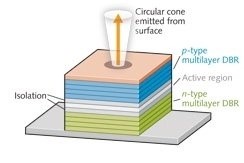
Laser Diodes and VCSELs are semiconductor lasers,  the simplest form of Solid State Lasers.  Laser diodes are commonly referred to as edge emitting laser diodes because the laser light is emitted from the edge of the substrate. The light emitting region of the laser diode is commonly called the emitter.  The emitter size and the quantity of emitters determine output power and beam quality of a laser diode. These Fabry Perot Diode Lasers with a single emission region (Emitter) are typically called laser diode chips, while a linear array of emitters is called laser diode bars. Laser diode bars typically use multimode emitters, the number of emitters per substrate can vary from 5 emitters to 100 emitters. VCSELs (Vertical Cavity Surface Emitting Laser) emit light perpendicular to the mounting surface as opposed to parallel like edge emitting laser diodes.  VCSELs offer a uniform spatial illumination in a circular illumination pattern with low speckle. If you want to read more about lasers in general, and help narrowing down the selection to find the right laser for you, check out our Knowledge Center for our Blogs, Whitepapers, and FAQ pages, as well as our Lasers 101 Page!VCSEL

What’s the difference between single transverse mode & single longitudinal mode?

What’s the difference between single transverse mode & single longitudinal mode?

Within the laser community, one of the most overused and often miscommunicated terms is the phrase “single mode.”  This is because a laser beam when traveling through air takes up a three-dimensional volume in space similar to that of a cylinder; and just as with a cylinder, a laser beam can be divided into independent coordinates each with their own mode structure.  For a cylinder we would call these the length and the cross-section, but as shown in the figure below for a laser beam, we define these as the transverse electromagnetic (TEM) plane and the longitudinal axis.   Both sets of modes are fundamental to the laser beam’s properties, since the TEM modes determine the spatial distribution of the laser beams intensity, and the longitudinal modes determine the spectral properties of the laser.  As a result, when a laser is described as being “single-mode” first you need to make sure that you truly understand which mode is being referred to.  Meaning that you must know if the laser is single transverse mode, single longitudinal mode, or both. Get all the information you need in this article: “What is Single Longitudinal Mode?” Get more information from our Lasers 101, Blogs, Whitepapers, FAQs, and Press Release pages in our Knowledge Center!