
 BUY NOW

How trigger delay, timing jitter, repetition rate & pulse-on-demand operation affect laser synchronization
A pulsed laser can meet an application’s wavelength, pulse width, energy, and beam requirements and still be the wrong source if the optical pulse does not occur when the system expects it.
For applications that synchronize a laser with a detector, camera, ranging system, experiment, or another timed event, it is important to understand several related but different specifications: triggering, trigger delay, timing jitter, repetition rate, and pulse-on-demand capability.
These terms are sometimes treated as interchangeable. They are not. Understanding the difference helps determine whether a standard pulsed laser is sufficient or whether tighter timing control is actually required.
Why Laser Timing Matters
In many pulsed-laser applications, the important question is not only how often the laser fires, but when a specific optical pulse occurs relative to an electrical or system event.
For example, a detector may need to open a narrow acquisition window immediately after a laser pulse, a camera exposure may need to be synchronized with illumination, or a ranging system may calculate distance from the elapsed time between laser emission and a returned signal.
In these systems, the laser’s timing behavior becomes part of the overall timing budget.
Internal vs. External Laser Triggering
Internal Triggering
The laser’s own electronics determine when pulses are generated, typically according to a fixed or adjustable repetition rate. This can be sufficient when the system does not need to command the timing of individual pulses.
External Triggering
An external electrical signal initiates or coordinates laser operation. This allows the laser to synchronize with another device or system event, subject to the laser’s allowable trigger frequency, delay, pulse-generation architecture, and electrical-interface requirements.
Externally triggerable does not automatically mean true pulse-on-demand operation. Some lasers accept an external trigger but still impose restrictions on repetition rate, charging time, trigger spacing, gating, or pulse-energy behavior.
Trigger Delay vs. Timing Jitter
When an external trigger is applied, the optical pulse usually does not appear instantaneously. Electronics, driver circuitry, switching mechanisms, and laser pulse build-up introduce a measurable delay between the electrical trigger and optical output.
| Trigger Delay | The time between the electrical trigger event and the resulting optical pulse. |
| Timing Jitter | Pulse-to-pulse variation in that trigger-to-optical-output timing. |
| Repetition Rate | How frequently the laser produces pulses. |
| Synchronization | Coordinating the laser pulse with another device, measurement, or system event. |
A long trigger delay is not necessarily the same problem as high jitter. A laser can have a relatively long but highly repeatable delay that the system compensates for. Conversely, a short average delay with large pulse-to-pulse variation may be unsuitable when the optical pulse must arrive inside a narrow timing window.
Trigger Delay vs. Timing Jitter
The source of timing variation depends on the laser architecture. In an actively Q-switched DPSS laser, possible contributors include:
- Electrical noise in the trigger and driver chain
- Pulse-to-pulse variation in electrical switching behavior
- Q-switch response and driver timing
- Variation in laser pulse build-up inside the resonator
- Variation in the trigger signal’s edge shape or timing
- Operating-state or temperature-dependent changes
The result is that the trigger-to-pulse delay is not identical for every pulse.
Check how a manufacturer defines the quoted jitter specification. Depending on the laser and manufacturer, timing variation may be reported as RMS, standard deviation, peak-to-peak, or another statistical measure. Values should only be compared when their definitions and measurement conditions are understood.
Example: Measuring Trigger-to-Pulse Jitter
The oscilloscope example below shows a low-jitter Bright Solutions pulsed laser. The electrical trigger is compared with the optical pulse measured using a fast photodiode.
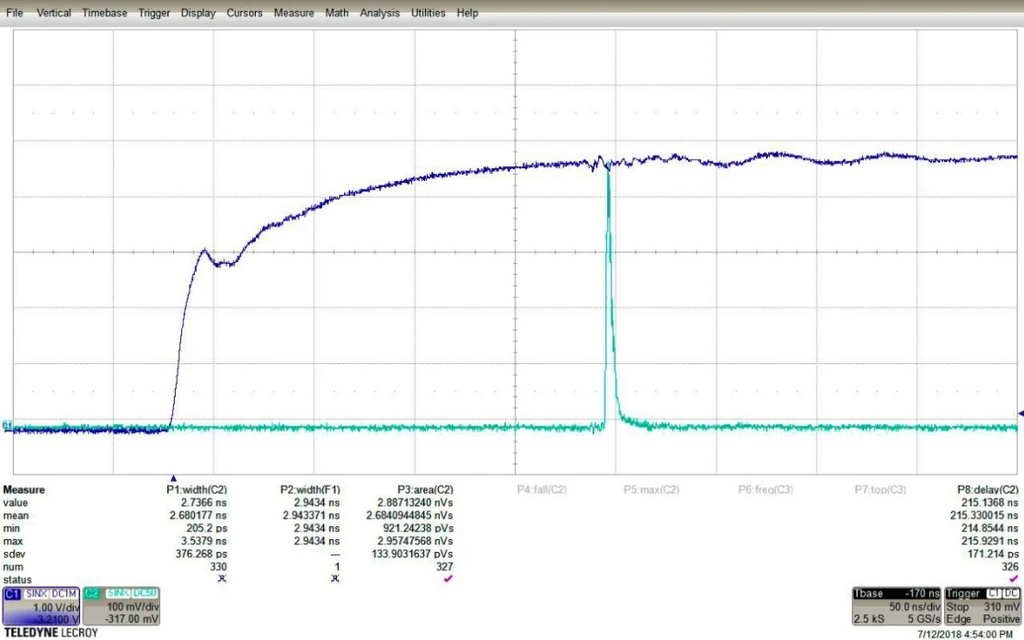
Rather than looking only at the average delay, repeated measurements are used to determine how much that delay varies from pulse to pulse.

In this example, the measured average trigger-to-pulse delay is approximately 215 ns, while the standard deviation of that delay is approximately 171 ps. The key point is that the average delay and the variation around that delay are separate specifications.
When Does Low Timing Jitter Actually Matter?
Lower timing jitter is not automatically better for every pulsed-laser application. It becomes important when variation in the arrival time of the optical pulse is significant compared with the timing window or measurement uncertainty of the complete system.
Applications where laser timing can be especially important include:
- Time-of-flight ranging and LiDAR – where laser timing contributes to distance uncertainty.
- Gated imaging and detection – where a detector is opened during a defined time window.
- Camera synchronization – where illumination must occur at a controlled point in the exposure cycle.
- Pump-probe and time-coordinated experiments – where one event must occur at a known time relative to another.
- LIBS and gated spectroscopy – where detection timing may be coordinated with plasma formation and decay.
- Multi-laser or multi-channel systems – where several timed events must remain synchronized.
- Machine or position-synchronized processes – where a pulse must occur at a specific point in an external process.
By contrast, if the detector or process operates over a much longer time scale than the laser’s timing variation, reducing jitter further may provide little practical benefit.
When Does Low Timing Jitter Actually Matter?
Time-of-flight ranging is a useful example because both trigger timing and optical detection affect the distance calculation. A laser pulse is sent toward a target, and the system measures the elapsed time before reflected or backscattered light returns to the detector.
A 3 ns optical pulse occupies approximately 0.9 m of physical length in free space:
c × 3 ns ≈ 0.9 m
For a simple round-trip time-of-flight measurement, however, a 3 ns interval corresponds to approximately 0.45 m of one-way distance because the measured light travels to the target and back.
The approximate contribution of timing uncertainty to one-way distance uncertainty is:
Distance uncertainty ≈ c × timing uncertainty ÷ 2
| Timing Uncertainty | Approx. One-Way Distance Equivalent |
|---|---|
| 1 ns | 15 cm |
| 200 ps | 3 cm |
| 171 ps | ≈2.6 cm |
This does not mean a laser with 200 ps jitter automatically produces 3 cm ranging accuracy. The laser’s timing uncertainty is only one contributor. Detector response, electronics, signal processing, target return, atmospheric conditions, calibration, and other system errors also affect the final measurement.
Adjustable Repetition Rate vs. Trigger Control
Repetition rate and trigger control are related, but they describe different things.
Adjustable repetition rate describes the range of pulse frequencies at which a laser can operate. A laser may, for example, operate from single-shot or low-Hz conditions through kHz or MHz repetition rates depending on its architecture.
External trigger control describes how the timing of an individual pulse or pulse sequence can be coordinated with another signal or event.
An adjustable-repetition-rate laser is not automatically a low-jitter or pulse-on-demand laser. Likewise, a laser with excellent trigger repeatability may still operate over only a limited repetition-rate range.
Changing repetition rate can also affect pulse energy, average power, thermal behavior, pulse width, or other output characteristics. These dependencies need to be checked at the actual operating point rather than assuming the laser performs identically across its full repetition-rate range.
Compare Adjustable Repetition Rate Lasers →
Single-Shot & Pulse-on-Demand Operation
Single-shot capability and pulse-on-demand operation should also be distinguished.
Single-shot operation means the laser can produce an isolated pulse under defined operating conditions.
Pulse-on-demand operation generally means individual pulses can be commanded by the user or system, subject to the laser’s defined timing response, allowable trigger spacing, operating range, and pulse-generation conditions.
Not every externally triggered or single-shot laser provides the same level of pulse timing control. If the application requires a pulse at a specific event rather than simply a low repetition rate, that requirement should be stated explicitly during laser selection.
Synchronizing a Laser to a Detector, Camera or Experiment
When selecting a laser for a synchronized system, start with the device or event the laser must coordinate with rather than simply asking for the lowest available jitter number.
Useful questions include:
- What generates the master timing signal?
- Does the laser receive the trigger, generate the trigger, or both?
- How much trigger-to-output delay is acceptable?
- How much pulse-to-pulse timing variation can the system tolerate?
- Does the delay need to be adjustable or simply repeatable?
- What trigger frequency range is required?
- Are isolated pulses or pulse-on-demand operation required?
- What electrical trigger levels, impedance, pulse width, and edge requirements must be supported?
Electrical interface requirements are laser-specific. Do not assume every externally triggered laser uses the same TTL level, impedance, trigger polarity, or edge requirements.
What Laser Timing Specifications Should I Provide?
If timing or synchronization matters to your application, provide the requirements you already know. Useful starting points include:
|
Not sure which timing specifications actually matter? |
You do not need every value finalized before contacting RPMC. Tell us what the laser must synchronize with, the timing window the system can tolerate, and the optical performance you need. RPMC can help down-select the available laser architectures and configurations.
Related laser selections:
Low Jitter Lasers | Adjustable Repetition Rate Lasers